Skip to content
doubtly
Topic: Spring oscillations, restoring force, force constant· Oscillations and Waves

In an oscillating spring mass system, a spring is connected to a box filled with sand. As the box oscillates, sand leaks slowly out of the box vertically so that the average frequency ω(t) and average amplitude A(t) of the system change with time t.…

In an oscillating spring mass system, a spring is connected to a box filled with sand. As the box oscillates, sand leaks slowly out of the box vertically so that the average frequency \(\omega(t)\) and average amplitude \(A(t)\) of the system change with time \(t\). Which one of the following options schematically depicts these changes correctly?
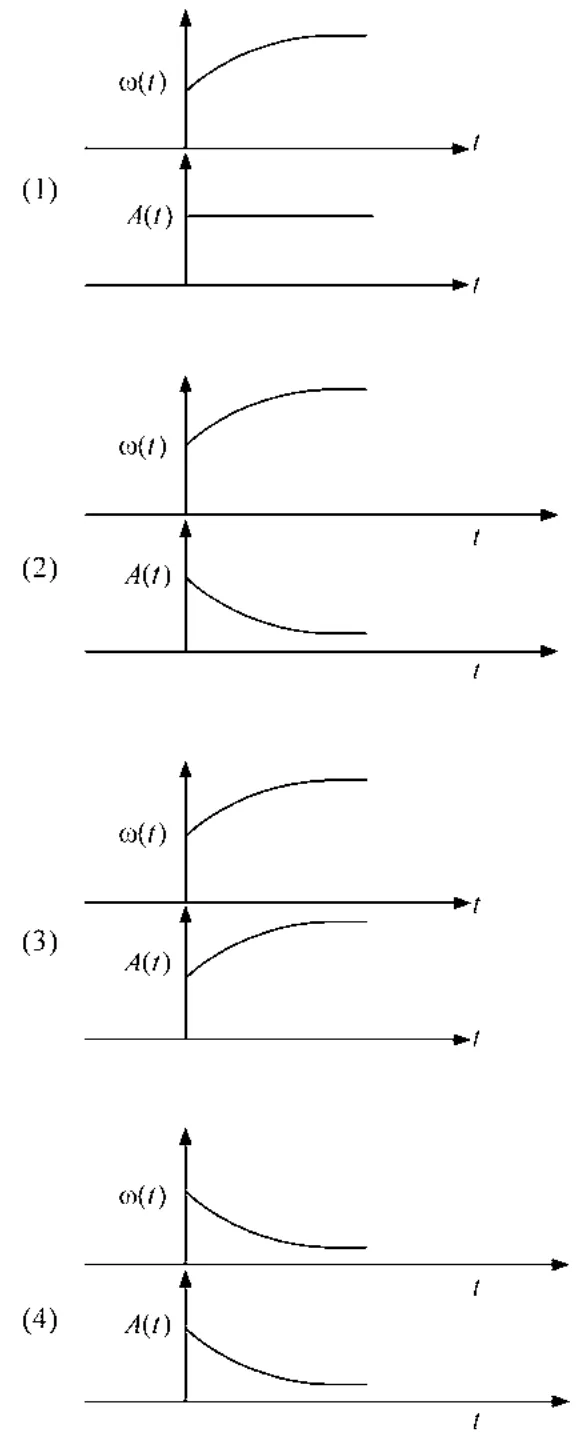
four options each with two graphs, omega(t) above and A(t) below vs t

1. Graph pair: \(\omega(t)\) rises and saturates; \(A(t)\) constant

2. Graph pair: \(\omega(t)\) rises and saturates; \(A(t)\) decays

3. Graph pair: \(\omega(t)\) rises and saturates; \(A(t)\) rises and saturates

4. Graph pair: \(\omega(t)\) decays; \(A(t)\) decays

1 answer

Best answer

Answer: 2. Graph pair: \(\omega(t)\) rises and saturates; \(A(t)\) decays

Key idea: the frequency of a spring-mass system is \(\omega=\sqrt{k/m}\), and sand leaking vertically carries no horizontal momentum.

  • As mass \(m\) decreases, \(\omega\) increases, and it levels off as the sand runs out (graph rising and saturating).
  • The sand leaves vertically, so at the mean position the speed of the box is unchanged. Since \(v_{max}=A\omega\), a larger \(\omega\) means a smaller amplitude \(A=v_{max}/\omega\), so \(A\) decreases.

Only option 2 shows \(\omega\) rising and \(A\) falling. Option 1 shows constant \(A\), option 3 shows rising \(A\), and option 4 shows falling \(\omega\), all of which are wrong.

Doubtly AI · 30 Oct 2026 AI-generated · not yet verified Report
Was this answer helpful?

Your answer

Log in or create a free account to answer this question.