2 answers
Best answer
Answer: Doping Ge with antimony (Sb) gives an n-type semiconductor; the majority charge carriers are electrons.
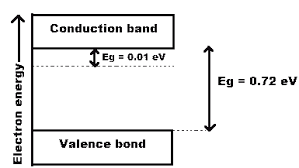
Why: Germanium is tetravalent. Antimony is pentavalent (5 valence electrons). When an Sb atom replaces a Ge atom, four of its electrons form covalent bonds with the neighbouring Ge atoms and the fifth electron is only loosely bound. Very little energy (about 0.01 eV in Ge) frees it into the conduction band. Sb therefore donates electrons and is called a donor impurity.
Energy band diagram (how to draw it):
- Draw the valence band (VB) as a shaded strip at the bottom and the conduction band (CB) as a strip at the top, separated by the forbidden gap \(E_g\) (about 0.7 eV for Ge).
- Just below the bottom edge of the conduction band, draw a dashed horizontal line labelled donor level \(E_D\). Its gap from the conduction band is very small (about 0.01 eV).
- Show the donor electrons on the donor level, and arrows from the donor level up into the conduction band: at room temperature almost all donor electrons have moved into the CB.
- Show many electrons in the CB and only a few holes in the VB (holes produced by thermal breaking of bonds).
- Extrinsic semiconductor obtained: n-type semiconductor
- Majority charge carriers: electrons
- Minority charge carriers: holes

Answer: Doping Ge with antimony (Sb, group 15) gives an n-type semiconductor; its majority charge carriers are electrons.
Antimony is pentavalent. Four of its five valence electrons form covalent bonds with neighbouring Ge atoms; the fifth electron is only loosely bound. Sb is therefore a donor impurity.
Energy band diagram (draw it like this):
Energy
^ =================== Conduction band (CB)
| e e e e e (many free electrons)
| - - - - - - - - - - Donor level E_D
| (about 0.01 eV below CB in Ge)
|
| Forbidden gap (E_g about 0.7 eV for Ge)
|
| =================== Valence band (VB)
| o o (a few holes)
- The donor energy level \(E_D\) lies just below the bottom of the conduction band.
- Even at room temperature the extra electrons easily jump from the donor level into the conduction band, so the conduction band has many electrons.
- Only a few holes are present in the valence band (from thermal breaking of bonds).
Name: n-type (donor-type) extrinsic semiconductor. Majority carriers: electrons. Minority carriers: holes.
Practise this chapter
Your answer
Log in or create a free account to answer this question.