Chapter: Elements of Group 1 and 2· Chemistry
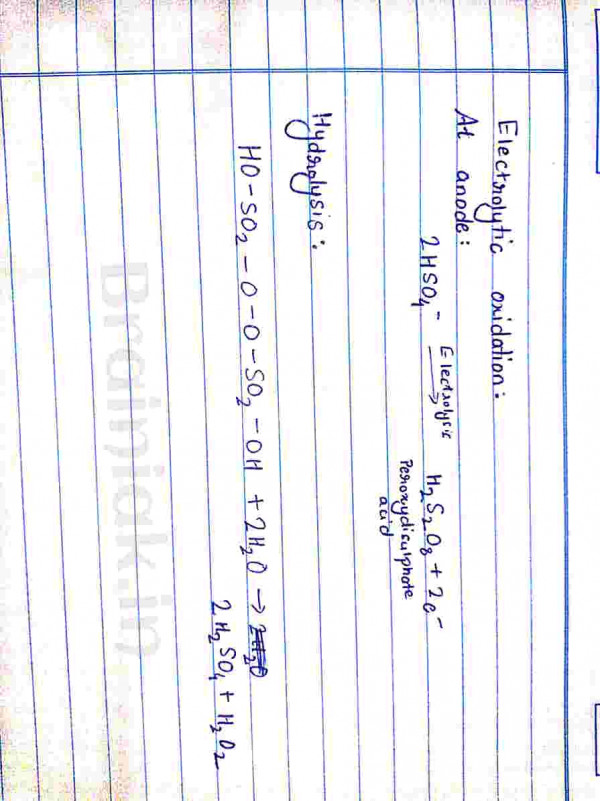
Answer: Electrolytic oxidation of 50% H2SO4 gives peroxodisulphuric acid (H2S2O8), which on hydrolysis gives hydrogen peroxide (H2O2).
Step 1: Electrolytic oxidation
When 50% sulphuric acid is electrolysed (using a high current density), hydrogensulphate ions are oxidized at the anode to peroxodisulphate:
\( 2\mathrm{HSO_4^{-}(aq)} \rightarrow \mathrm{HO_3SOOSO_3H(aq)} + 2e^{-} \)
Overall, \( 2\mathrm{H_2SO_4} \xrightarrow{\text{electrolysis}} \mathrm{H_2S_2O_8} + \mathrm{H_2} \) (hydrogen is liberated at the cathode).
Step 2: Hydrolysis
Peroxodisulphuric acid is hydrolysed with water to give hydrogen peroxide and sulphuric acid:
\( \mathrm{H_2S_2O_8} + 2\mathrm{H_2O} \rightarrow 2\mathrm{H_2SO_4} + \mathrm{H_2O_2} \)
The H2O2 formed is distilled off under reduced pressure, and the H2SO4 is used again.