Chapter: Rotational Dynamics· Physics
Answer: Osmotic pressure is the excess hydrostatic pressure that must be applied on the solution to just stop the osmosis of pure solvent into it through a semipermeable membrane. It is given by \(\pi = CRT\).
Osmosis: When a solution and its pure solvent are separated by a semipermeable membrane (which lets only solvent molecules pass), the solvent flows spontaneously from the pure solvent into the solution (or from a dilute to a concentrated solution). This is osmosis.
Osmotic pressure (\(\pi\)):
- Because of osmosis the level of the solution rises. If a pressure is applied on the solution side, the flow of solvent can be stopped.
- The minimum excess pressure on the solution that just stops the flow of solvent into it is called its osmotic pressure.
- It is a colligative property: it depends on the number of solute particles, not on their nature.
van't Hoff equation:
\(\pi = CRT = \dfrac{n_2}{V}RT\)
where \(C\) = molar concentration of solution, \(R\) = gas constant, \(T\) = absolute temperature, \(n_2\) = moles of solute, \(V\) = volume of solution in litres (with \(R = 0.08206\ \text{L atm K}^{-1}\text{mol}^{-1}\), \(\pi\) is in atm).
Since \(n_2 = \dfrac{W_2}{M_2}\), it also gives the molar mass of solute: \(M_2 = \dfrac{W_2RT}{\pi V}\).
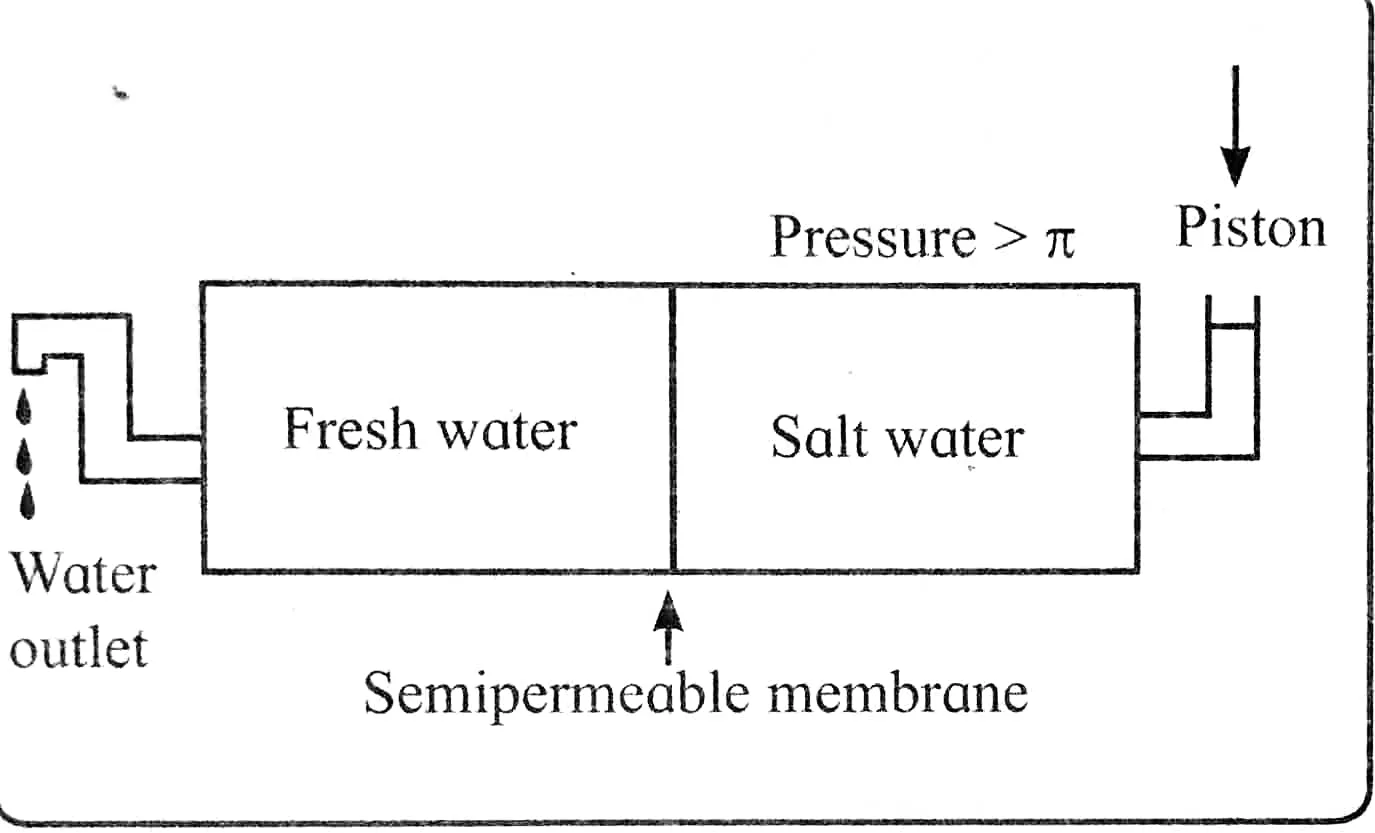
Reverse osmosis: If a pressure larger than the osmotic pressure is applied on the solution, pure solvent flows out of the solution into the solvent side through the membrane. This is used to obtain fresh water from sea water.