Skip to content
doubtly

2 answers

Best answer

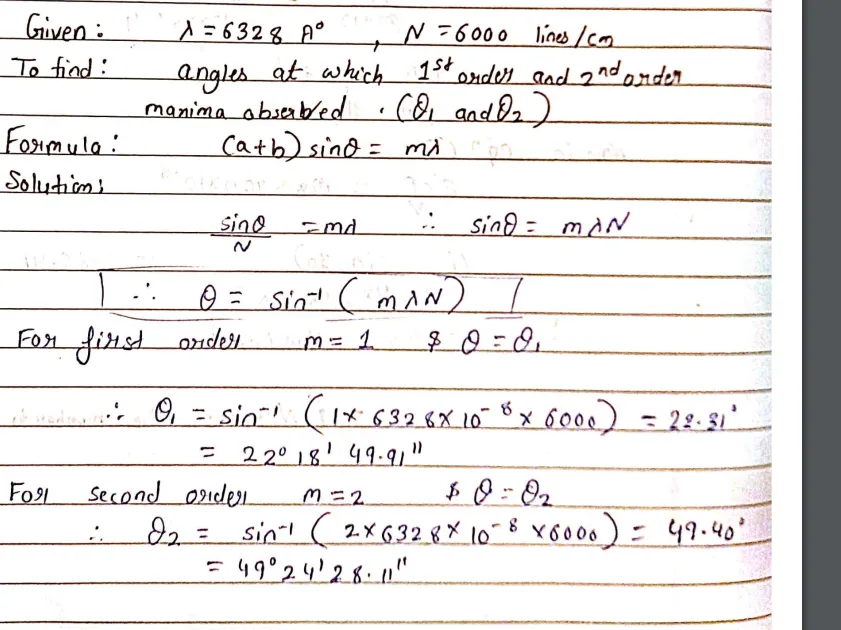
Answer: First order at \(\theta_1 = 22.3^\circ\), second order at \(\theta_2 = 49.4^\circ\)

Grating equation: \((a+b)\sin\theta = n\lambda\).

\((a+b) = \dfrac{1}{6000}\ \text{cm} = 1.667 \times 10^{-4}\) cm, \(\lambda = 6328\ \text{Å} = 6.328 \times 10^{-5}\) cm.

First order (n = 1): \(\sin\theta_1 = \dfrac{6.328 \times 10^{-5}}{1.667 \times 10^{-4}} = 0.3797 \Rightarrow \theta_1 = 22.3^\circ\)

Second order (n = 2): \(\sin\theta_2 = 2 \times 0.3797 = 0.7594 \Rightarrow \theta_2 = 49.4^\circ\)

image

Doubtly · 10 Apr 2022 Report
Was this answer helpful?

Answer: First order at about \(22.3^\circ\), second order at about \(49.4^\circ\)

Grating element:

\[d = \frac{1}{6000}\ \mathrm{cm} = 1.667\times10^{-6}\ \mathrm{m}\]

Grating equation at normal incidence: \(d\sin\theta = n\lambda\), with \(\lambda = 6328\ \text{Å} = 6.328\times10^{-7}\ \mathrm{m}\).

First order (\(n = 1\)):

\[\sin\theta_1 = \frac{6.328\times10^{-7}}{1.667\times10^{-6}} = 0.3797\]

\[\theta_1 \approx 22.3^\circ\]

Second order (\(n = 2\)):

\[\sin\theta_2 = 2\times0.3797 = 0.7594\]

\[\theta_2 \approx 49.4^\circ\]

Doubtly AI · 23 Oct 2026 AI-verified · Oct 2026 Report
Was this answer helpful?

Your answer

Log in or create a free account to answer this question.