Skip to content
doubtly

1 answer

Best answer

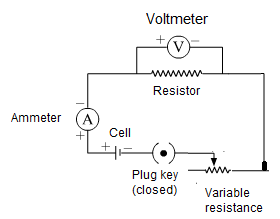
Answer: The completed circuit verifies Ohm's law (\( V = IR \)).

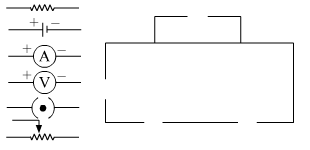
Placing the components:

  • Connect the cell (battery), the plug key, the ammeter, the resistor (conductor, e.g. nichrome wire) and the rheostat one after the other in a single loop, i.e. in series.
  • Connect the ammeter in series so that the whole current passes through it; its + terminal goes towards the + terminal of the cell.
  • Connect the voltmeter in parallel (across the two ends) of the resistor, with its + terminal on the side connected to the + terminal of the cell.
  • The rheostat in series is used to change the current in the circuit.

Law proved: Ohm's law. By changing the rheostat, several readings of current (I, from the ammeter) and potential difference (V, from the voltmeter) are taken. The ratio \( V/I \) comes out constant, and the V–I graph is a straight line through the origin, showing \( I \propto V \), i.e. \( V = IR \).

Doubtly · 11 Apr 2022 Report
Was this answer helpful?

Practise this chapter

Current Electricity

Your answer

Log in or create a free account to answer this question.