Skip to content
doubtly

2 answers

Best answer

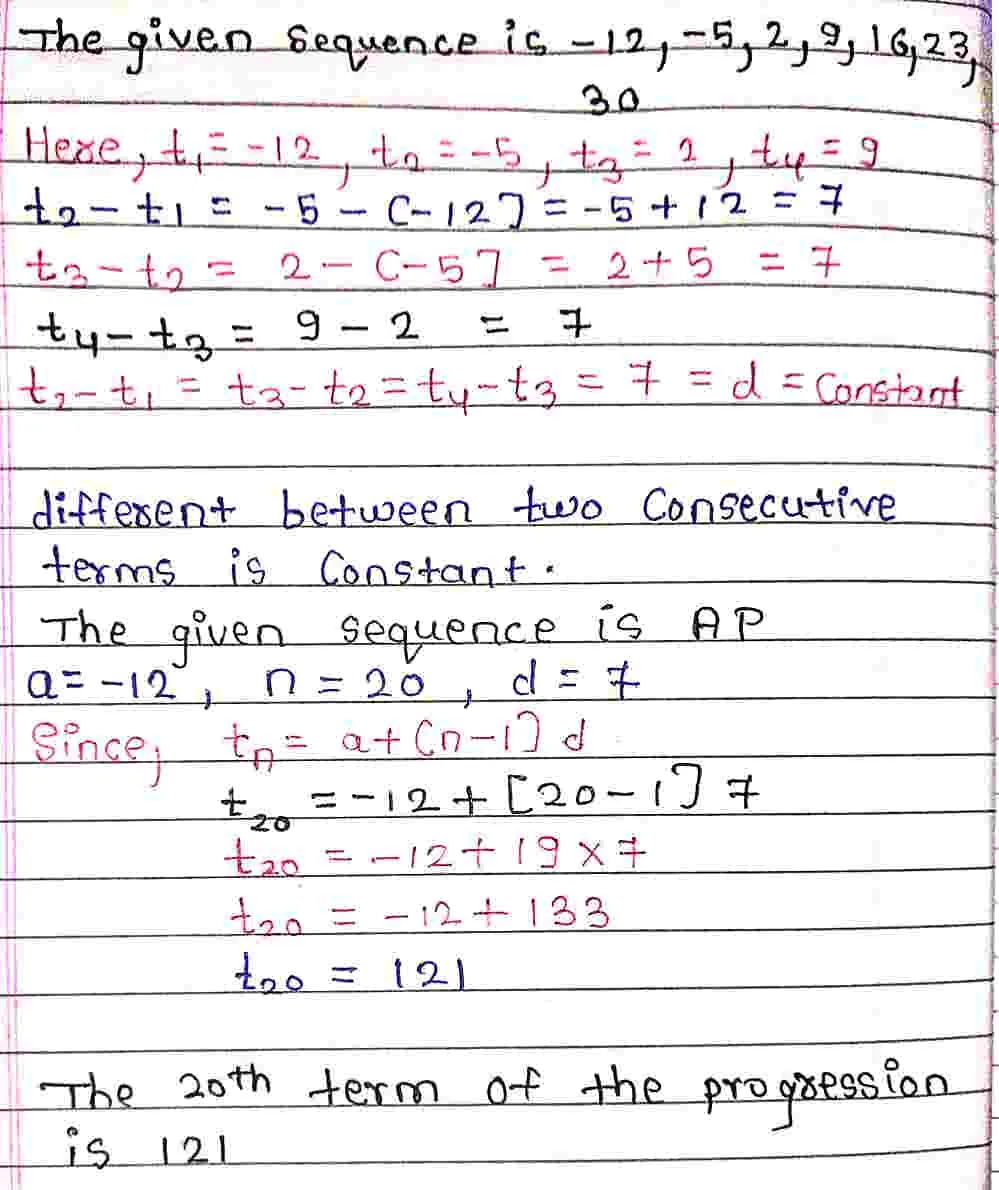
Answer: Yes, it is an A.P. with d = 7, and its 20th term is 121.

Given sequence: −12, −5, 2, 9, 16, 23, 30, ...

Difference between consecutive terms:

\(t_2 - t_1 = -5 - (-12) = 7\)

\(t_3 - t_2 = 2 - (-5) = 7\)

\(t_4 - t_3 = 9 - 2 = 7\)

\(t_5 - t_4 = 16 - 9 = 7\), \(t_6 - t_5 = 23 - 16 = 7\), \(t_7 - t_6 = 30 - 23 = 7\)

The difference is the same (7) every time, so the sequence is an A.P. with \(a = -12\) and \(d = 7\).

\(t_n = a + (n - 1)d\)

\(t_{20} = -12 + (20 - 1) \times 7 = -12 + 19 \times 7 = -12 + 133 = 121\)

Hence the 20th term of the A.P. is 121.

Solution

Anonymous · 29 Apr 2021 Report
Was this answer helpful?

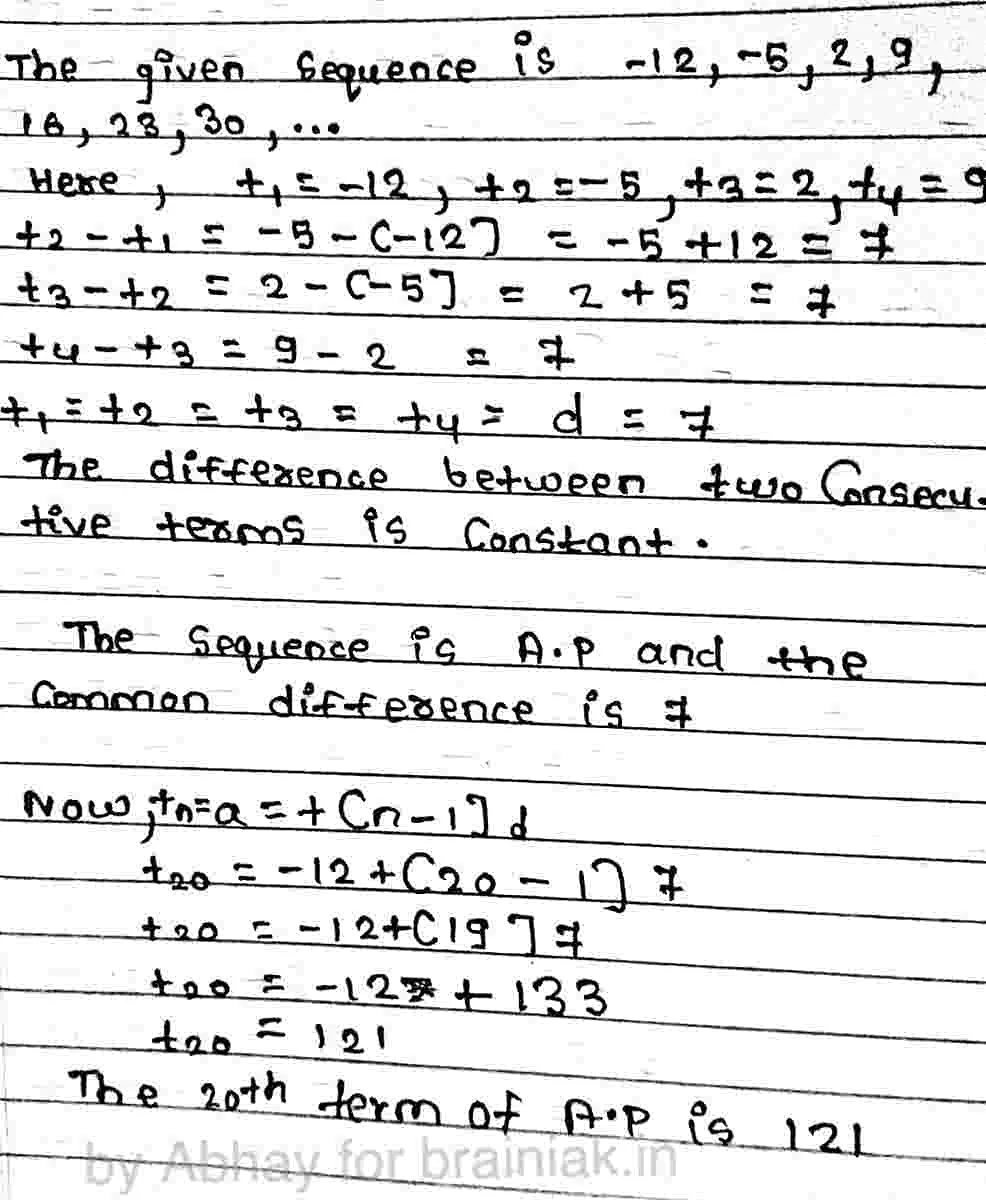
Answer: Yes, it is an A.P. with d = 7, and its 20th term is 121.

Given sequence: −12, −5, 2, 9, 16, 23, 30, ...

Difference between consecutive terms:

\(t_2 - t_1 = -5 - (-12) = 7\)

\(t_3 - t_2 = 2 - (-5) = 7\)

\(t_4 - t_3 = 9 - 2 = 7\)

\(t_5 - t_4 = 16 - 9 = 7\), \(t_6 - t_5 = 23 - 16 = 7\), \(t_7 - t_6 = 30 - 23 = 7\)

The difference is the same (7) every time, so the sequence is an A.P. with \(a = -12\) and \(d = 7\).

\(t_n = a + (n - 1)d\)

\(t_{20} = -12 + (20 - 1) \times 7 = -12 + 19 \times 7 = -12 + 133 = 121\)

Hence the 20th term of the A.P. is 121.

Solution

Topper · 24 Apr 2021 Report
Was this answer helpful?

Practise this chapter

Arithmetic Progression

Take the chapter test 10 questions · 15 min · free

Your answer

Log in or create a free account to answer this question.