Skip to content
doubtly

2 answers

Best answer

Answer: Defining the radius of gyration lets us write the moment of inertia of any body in the simple form \(I = MK^2\), as if its whole mass were at one distance \(K\) from the axis. This makes it easy to compare how mass is distributed in different bodies and simplifies rotational calculations.

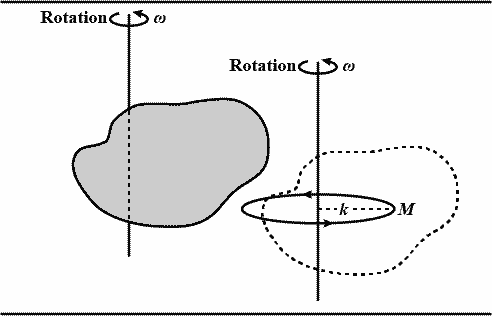
Definition: The radius of gyration \(K\) of a body about an axis is the distance from the axis at which, if the whole mass \(M\) of the body were concentrated, its moment of inertia about that axis would remain the same.

\(I = MK^2 \Rightarrow K = \sqrt{\dfrac{I}{M}}\)

Why it is useful:

  • A real body has mass spread over many distances from the axis. \(K\) replaces this spread by a single equivalent distance, so a rotating body can be treated like a single particle of mass \(M\) at distance \(K\).
  • \(K\) does not depend on the mass of the body; it depends only on its shape, size and the position of the axis. So it directly tells how the mass is distributed about the axis. For example, about its central axis a thin ring has \(K = R\) while a uniform disc has \(K = R/\sqrt2\): the ring has its mass farther from the axis.
  • Bodies of different masses but the same shape have the same \(K\), so one value can be used for all of them, and different shapes can be compared easily.
  • Formulas become simpler, e.g. KE of a rolling body \(E = \tfrac12 mv^2\left(1 + \dfrac{K^2}{R^2}\right)\) and acceleration down an incline \(a = \dfrac{g\sin\theta}{1 + K^2/R^2}\). The ratio \(K^2/R^2\) alone decides which body rolls down faster.
Doubtly · 18 May 2021 Report
Was this answer helpful?

Radius of gyration lets us write the moment of inertia of any body in the simple form \(I = MK^{2}\), as if all its mass were at one distance \(K\) from the axis, so it describes how the mass is distributed about the axis independently of the total mass.

Definition: The radius of gyration \(K\) of a body about an axis is the distance from the axis at which the whole mass \(M\) of the body could be concentrated so that its moment of inertia about that axis stays the same:

\[I = MK^{2} \quad\Rightarrow\quad K = \sqrt{\frac{I}{M}}\]

Why it is useful:

  • For a body of any shape, the MI (\(I = \sum m_i r_i^{2}\)) can be written like that of a single particle, \(I = MK^{2}\). This makes calculations and comparisons simple.
  • \(K\) depends only on the shape of the body and the position of the axis, i.e. on how the mass is distributed, not on the total mass. For example, for a thin ring about its axis \(K = R\), and for a disc about its axis \(K = R/\sqrt{2}\), whatever their masses.
  • So two bodies can be compared directly: the one with larger \(K\) has its mass spread farther from the axis and is harder to rotate or stop (useful in designing flywheels, wheels, beams).
  • Expressions for rolling motion, e.g. \(KE = \tfrac{1}{2}mv^{2}\left(1 + \tfrac{K^{2}}{R^{2}}\right)\), become compact using \(K\).
Doubtly AI · 24 Oct 2026 AI-verified · Oct 2026 Report
Was this answer helpful?

Practise this chapter

Rotational Dynamics

Take a 10-question test new questions each time · marked instantly · free

Your answer

Log in or create a free account to answer this question.