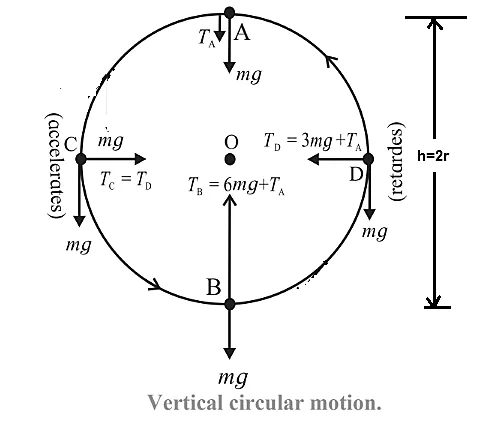
Answer: Minimum speeds: at the top \(v_A = \sqrt{rg}\), at the midway (horizontal) position \(v_M = \sqrt{3rg}\), at the bottom \(v_B = \sqrt{5rg}\). Zero speed at the top is possible only when the object is held by a rigid support (rod, or moving inside a tube/track), not by a string. The difference between the extreme tensions is \(T_B - T_A = 6mg\).
Consider a particle of mass \(m\) tied to a string and revolving in a vertical circle of radius \(r\) about centre O. A is the top point, B the bottom point and M a point at the level of O. Only two forces act on it: its weight \(mg\) (vertically down) and the tension \(T\) along the string towards the centre. The tension changes with position. If the speed is too small the string slackens before the top and the circle is not completed.
1. At the top (A): Both \(T_A\) and \(mg\) act towards the centre.
\(T_A + mg = \dfrac{mv_A^2}{r}\) ...(1)
For the minimum speed the string is just taut, \(T_A = 0\):
\(mg = \dfrac{mv_A^2}{r} \Rightarrow v_A = \sqrt{rg}\) ...(2)
2. At the bottom (B): B is \(2r\) below A. By conservation of mechanical energy (string tension does no work),
\(\tfrac12 mv_B^2 = \tfrac12 mv_A^2 + mg(2r)\)
\(v_B^2 = v_A^2 + 4gr\) ...(3)
With \(v_A^2 = rg\): \(v_B^2 = 5rg \Rightarrow v_B = \sqrt{5rg}\)
3. At the midway position (M): M is \(r\) below A.
\(\tfrac12 mv_M^2 = \tfrac12 mv_A^2 + mgr \Rightarrow v_M^2 = rg + 2rg = 3rg \Rightarrow v_M = \sqrt{3rg}\)
So, to complete the circle with a string, the particle must have at least \(\sqrt{5rg}\) at the bottom, \(\sqrt{3rg}\) at the midway point and \(\sqrt{rg}\) at the top.
Is zero speed possible at the top?
- With a string: no. A string can only pull, so at the top the centripetal force is at least \(mg\) and the speed must be at least \(\sqrt{rg}\).
- Yes, if the object is attached to a rigid rod or moves inside a tube/on a closed track. The rod or track can push outward, so at the top it can provide an upward force equal to \(mg\) and the object can just reach the top with \(v_A = 0\). In that case, from (3), the minimum speed at the bottom is \(v_B = \sqrt{4rg} = 2\sqrt{rg}\).
Difference between the extreme tensions:
At B, tension acts up (towards centre) and weight acts down:
\(T_B - mg = \dfrac{mv_B^2}{r}\) ...(4)
Subtracting (1) from (4):
\(T_B - T_A - 2mg = \dfrac{m}{r}(v_B^2 - v_A^2)\)
Using (3), \(v_B^2 - v_A^2 = 4gr\) (true for any speed, not only the minimum):
\(T_B - T_A = \dfrac{m}{r}(4gr) + 2mg = 6mg\)
Thus the difference between the tensions (or normal forces, for motion on a track) at the lowest and highest points is \(6mg\), which depends only on the weight of the object, not on its speed or the radius.