Skip to content
doubtly

2 answers

Answer: (D) \(-\dfrac{7}{9}\)

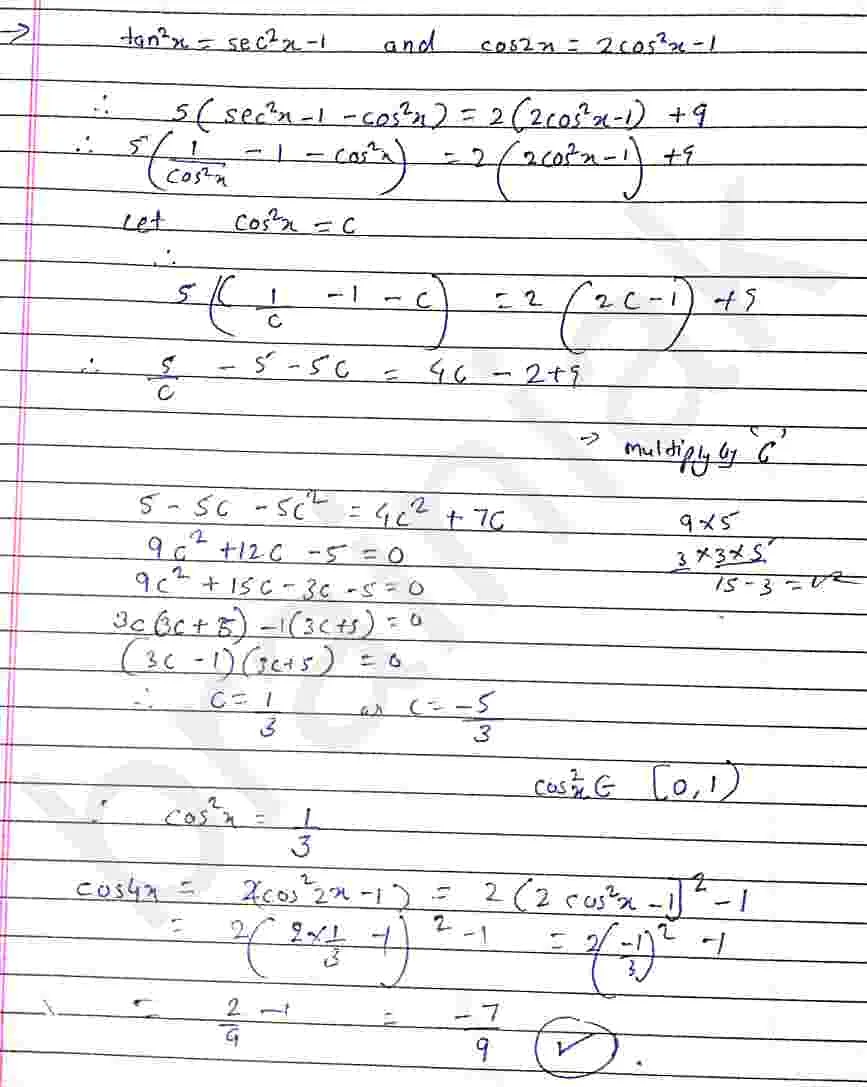
Let \(c = \cos^2 x\). Then \(\tan^2 x = \dfrac{1-c}{c}\) and \(\cos 2x = 2c - 1\).

The equation \(5(\tan^2 x - \cos^2 x) = 2\cos 2x + 9\) becomes

\[5\left(\frac{1-c}{c} - c\right) = 4c + 7\]

Multiply by \(c\):

\[5 - 5c - 5c^2 = 4c^2 + 7c\]

\[9c^2 + 12c - 5 = 0\]

\[(3c - 1)(3c + 5) = 0\]

\(c = -\frac{5}{3}\) is impossible, so \(\cos^2 x = \frac{1}{3}\).

Then \(\cos 2x = 2\cdot\frac{1}{3} - 1 = -\frac{1}{3}\), and

\[\cos 4x = 2\cos^2 2x - 1 = \frac{2}{9} - 1 = -\frac{7}{9}\]

Doubtly AI · 23 Oct 2026 AI-verified · Oct 2026 Report
Was this answer helpful?

Your answer

Log in or create a free account to answer this question.