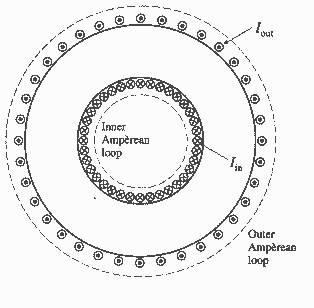
Answer: For any Amperean loop drawn outside an ideal toroid, the net current enclosed is zero, so by Ampere's law B = 0 outside.
Ampere's law: \(\oint \vec{B} \cdot d\vec{l} = \mu_0 I_{enc}\)
Consider an ideal toroid of N closely wound turns carrying current I. By symmetry, the field lines (if any) are circles concentric with the toroid, so on a circular loop of radius r centred on the toroid's axis, B is constant in magnitude and along \(d\vec{l}\). Hence \(\oint \vec{B} \cdot d\vec{l} = B(2\pi r)\).
Loop 1: Inside the hollow (inner) region, radius r smaller than the inner radius of the toroid. This loop does not pass through any winding, so no current crosses the surface bounded by it.
\(B(2\pi r) = \mu_0 \times 0 \Rightarrow B = 0\)
Loop 2: Outside the toroid, radius r larger than the outer radius. Every turn of the winding crosses the flat surface bounded by this loop twice: once going in (current I in one direction) on the inner side, and once coming out (current I in the opposite direction) on the outer side. So the net enclosed current is
\(I_{enc} = NI - NI = 0\)
\(B(2\pi r) = 0 \Rightarrow B = 0\)
Loop 3: A loop in any other plane outside the toroid (for example, a small loop beside the toroid not linking the windings) also encloses no net current, giving B = 0 on it.
(For comparison, a loop inside the core, between the inner and outer radii, encloses NI in one direction, giving \(B = \frac{\mu_0 N I}{2\pi r}\).)
Thus, for every choice of Amperean loop outside the windings, the enclosed current is zero, and so the magnetic field outside an ideal toroid is zero.