A particle moving with uniform speed in a circular path maintains :
Uniform circular motion
Every question from past board papers on Uniform circular motion, newest paper first. Open any question for its full worked answer.
NEET UG 2024 question paper (official, booklet S6)
Full paper →NEET UG 2023 question paper (official, booklet G6)
Full paper →-
The angular acceleration of a body, moving along the circumference of a circle, is :
NEET UG 2021 question paper (official, booklet M4)
Full paper →-
A particle moving in a circle of radius R with a uniform speed takes a time T to complete one revolution.
If this particle were projected with the same speed at an angle 'θ' to the horizontal, the maximum height attained by it equals 4R. The angle of projection, θ, is then given by :
NEET UG 2019 question paper (official, booklet P1)
Full paper →-
Two particles A and B are moving in uniform circular motion in concentric circles of radii \(r_A\) and \(r_B\) with speed \(v_A\) and \(v_B\) respectively. Their time period of rotation is the same. The ratio of angular speed of A to that of B will be :
NEET UG 2016 Phase 1 question paper (official, booklet A)
Full paper →-
A particle of mass 10 g moves along a circle of radius 6.4 cm with a constant tangential acceleration. What is the magnitude of this acceleration if the kinetic energy of the particle becomes equal to \(8\times10^{-4}\) J by the end of the second revolution after the beginning of the motion ?
-
A particle moves so that its position vector is given by \(\vec{r} = \cos\omega t\,\hat{x} + \sin\omega t\,\hat{y}\). Where \(\omega\) is a constant. Which of the following is true ?
NEET UG 2016 Phase 2 question paper (official, booklet ZZ)
Full paper →-
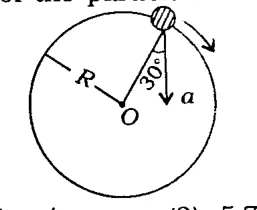
In the given figure, \(a=15\) m/s\(^2\) represents the total acceleration of a particle moving in the clockwise direction in a circle of radius \(R=2.5\) m at a given instant of time. The speed of the particle is