
A uniform rod of mass 20 kg and length 5 m leans against a smooth vertical wall making an angle of \(60^\circ\) with it. The other end rests on a rough horizontal floor. The friction force that the floor exerts on the rod is (take g = 10 m/s\(^2\))
Equilibrium of rigid bodies, rigid body rotation, equations of rotational motion
Every question from past board papers on Equilibrium of rigid bodies, rigid body rotation, equations of rotational motion, newest paper first. Open any question for its full worked answer.
NEET UG 2025 question paper (official, booklet 45)
Full paper →NEET UG 2024 question paper (official, booklet S6)
Full paper →-
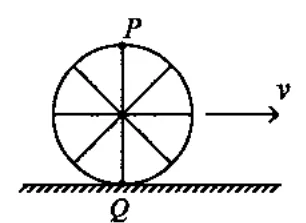
A wheel of a bullock cart is rolling on a level road as shown in the figure below. If its linear speed is \(v\) in the direction shown, which one of the following options is correct (\(P\) and \(Q\) are any highest and lowest points on the wheel, respectively)?
NEET UG 2021 question paper (official, booklet M4)
Full paper →-
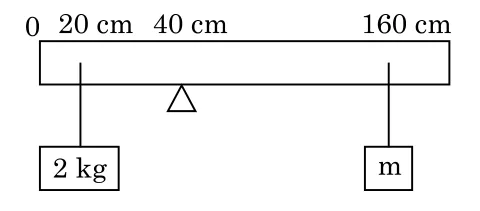
A uniform rod of length 200 cm and mass 500 g is balanced on a wedge placed at 40 cm mark. A mass of 2 kg is suspended from the rod at 20 cm and another unknown mass 'm' is suspended from the rod at 160 cm mark as shown in the figure. Find the value of 'm' such that the rod is in equilibrium. (g = 10 m/s\(^2\))
NEET UG 2017 question paper (official, booklet B)
Full paper →-
A rope is wound around a hollow cylinder of mass 3 kg and radius 40 cm. What is the angular acceleration of the cylinder if the rope is pulled with a force of 30 N ?
NEET UG 2016 Phase 1 question paper (official, booklet A)
Full paper →-
A uniform circular disc of radius 50 cm at rest is free to turn about an axis which is perpendicular to its plane and passes through its centre. It is subjected to a torque which produces a constant angular acceleration of \(2.0\ rad\ s^{-2}\). Its net acceleration in \(ms^{-2}\) at the end of 2.0 s is approximately :
-
A disk and a sphere of same radius but different masses roll off on two inclined planes of the same altitude and length. Which one of the two objects gets to the bottom of the plane first ?