An expert system is a computer program that is designed to solve complex problems and to provide decision-making ability like a human expert. It performs this by extracting knowledge from its knowledge base using the reasoning and inference rules according to the user queries.
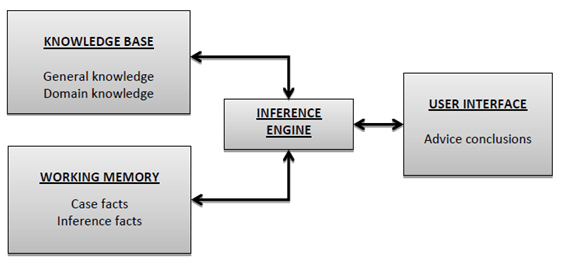
- User Interface (UI):
- This is the front end of the expert system that interacts with the user.
- It provides a way for users to input information and receive output from the system.
- The UI can take various forms, such as a graphical user interface (GUI) or a command-line interface (CLI), depending on the application.
- Knowledge Base (KB):
- The knowledge base is a central component of the expert system that stores information about the domain.
- It includes two main components: facts and rules.
- Facts: These are pieces of information about the specific case or domain. Facts are typically represented in the form of statements.
- Rules: These are logical statements that define relationships between various facts. Rules are used by the inference engine to make decisions.
- Inference Engine:
- The inference engine is responsible for drawing conclusions based on the information stored in the knowledge base.
- It uses various reasoning strategies, such as forward chaining (data-driven) or backward chaining (goal-driven), to infer new facts or make decisions.
- The inference engine interprets the rules and applies them to the given set of facts to derive new conclusions.
- Working Memory:
- Working memory is a temporary storage area where the current set of facts and conclusions are kept during the inference process.
- It is used by the inference engine to manipulate and update information as it processes the rules.
