Skip to content
doubtly

2 answers

Best answer

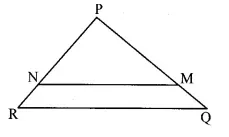
Answer: Yes, line NM ∥ side RQ, by the converse of the basic proportionality theorem.

In \(\triangle PQR\), point M lies on side PQ and point N lies on side PR.

PM = 15, PQ = 25, PR = 20, NR = 8

MQ = PQ − PM = 25 − 15 = 10

PN = PR − NR = 20 − 8 = 12

\(\frac{PM}{MQ} = \frac{15}{10} = \frac{3}{2}\) .....(1)

\(\frac{PN}{NR} = \frac{12}{8} = \frac{3}{2}\) .....(2)

From (1) and (2): \(\frac{PM}{MQ} = \frac{PN}{NR}\)

\(\therefore\) line NM ∥ side RQ .....(converse of basic proportionality theorem)

Doubtly · 3 Jul 2021 Report
Was this answer helpful?

Yes, line NM is parallel to side RQ, because \(\dfrac{PM}{MQ} = \dfrac{PN}{NR} = \dfrac{3}{2}\) (converse of the basic proportionality theorem).

In the figure, M lies on side PQ and N lies on side PR.

\[MQ = PQ - PM = 25 - 15 = 10\]

\[PN = PR - NR = 20 - 8 = 12\]

Now compare the ratios in which M and N divide the two sides:

\[\frac{PM}{MQ} = \frac{15}{10} = \frac{3}{2}\]

\[\frac{PN}{NR} = \frac{12}{8} = \frac{3}{2}\]

So \(\dfrac{PM}{MQ} = \dfrac{PN}{NR}\).

By the converse of the basic proportionality theorem, if a line divides two sides of a triangle in the same ratio, it is parallel to the third side. Hence line NM \(\parallel\) side RQ.

Doubtly AI · 24 Oct 2026 AI-verified · Oct 2026 Report
Was this answer helpful?

Practise this chapter

Similarity

Take the chapter test 10 questions · 15 min · free

Your answer

Log in or create a free account to answer this question.