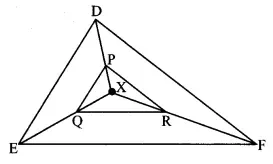
Answer: In ∆XDE, PQ ∥ DE gives \(\dfrac{XP}{PD}=\dfrac{XQ}{QE}\); in ∆XEF, QR ∥ EF gives \(\dfrac{XQ}{QE}=\dfrac{XR}{RF}\); so \(\dfrac{XP}{PD}=\dfrac{XR}{RF}\) and, by the converse of the basic proportionality theorem, seg PR ∥ seg DF.
Given: X is a point in the interior of ∆DEF; P, Q, R lie on seg XD, seg XE, seg XF respectively; seg PQ ∥ seg DE, seg QR ∥ seg EF.
To prove: seg PR ∥ seg DF.
Proof:
In ∆XDE, seg PQ ∥ seg DE [Given]
\(\therefore \dfrac{XP}{PD}=\dfrac{XQ}{QE}\) ...(I) [Basic proportionality theorem]
In ∆XEF, seg QR ∥ seg EF [Given]
\(\therefore \dfrac{XQ}{QE}=\dfrac{XR}{RF}\) ...(II) [Basic proportionality theorem]
From (I) and (II), \(\dfrac{XP}{PD}=\dfrac{XR}{RF}\) ...(III)
In ∆XDF, from (III), points P and R divide sides XD and XF in the same ratio.
\(\therefore\) seg PR ∥ seg DF [Converse of basic proportionality theorem]