Skip to content
doubtly

2 answers

Best answer

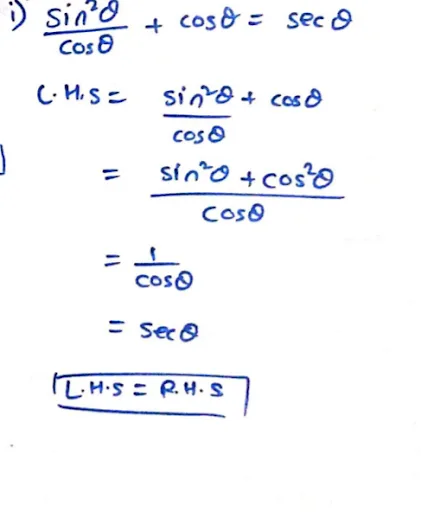
Answer: \(\dfrac{\sin^2\theta}{\cos\theta}+\cos\theta=\sec\theta\) is proved below.

LHS \(= \dfrac{\sin^2\theta}{\cos\theta}+\cos\theta\)

\(= \dfrac{\sin^2\theta+\cos^2\theta}{\cos\theta}\) (taking the LCM)

\(= \dfrac{1}{\cos\theta}\) (since \(\sin^2\theta+\cos^2\theta=1\))

\(= \sec\theta\) = RHS

\(\therefore \dfrac{\sin^2\theta}{\cos\theta}+\cos\theta=\sec\theta\).

image

Doubtly · 30 Sep 2021 Report
Was this answer helpful?
1 reader found this helpful

Answer: \(\dfrac{\sin^{2}\theta}{\cos\theta} + \cos\theta = \sec\theta\) (proved below).

Start with the left-hand side and take the common denominator \(\cos\theta\):

\[\text{LHS} = \frac{\sin^{2}\theta}{\cos\theta} + \cos\theta\]

\[= \frac{\sin^{2}\theta + \cos^{2}\theta}{\cos\theta}\]

Using \(\sin^{2}\theta + \cos^{2}\theta = 1\):

\[= \frac{1}{\cos\theta} = \sec\theta = \text{RHS}\]

Hence proved.

Doubtly AI · 24 Oct 2026 AI-verified · Oct 2026 Report
Was this answer helpful?

Practise this chapter

Trigonometry

Take the chapter test 10 questions · 15 min · free

Your answer

Log in or create a free account to answer this question.