Skip to content
doubtly

2 answers

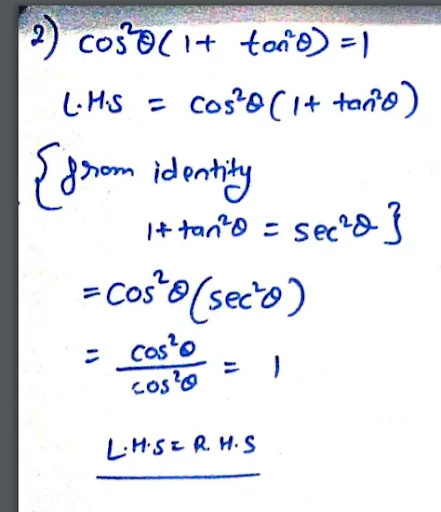
Answer: \(\cos^2\theta\,(1+\tan^2\theta) = \cos^2\theta\cdot\sec^2\theta = 1\)

Proof:

LHS \(= \cos^2\theta\,(1+\tan^2\theta)\)

Using the identity \(1+\tan^2\theta = \sec^2\theta\):

\[\text{LHS} = \cos^2\theta \times \sec^2\theta\]

Since \(\sec\theta = \dfrac{1}{\cos\theta}\):

\[\text{LHS} = \cos^2\theta \times \frac{1}{\cos^2\theta} = 1 = \text{RHS}\]

Hence proved.

Another way: \(\cos^2\theta + \cos^2\theta\cdot\dfrac{\sin^2\theta}{\cos^2\theta} = \cos^2\theta + \sin^2\theta = 1\).

Doubtly AI · 24 Oct 2026 AI-verified · Oct 2026 Report
Was this answer helpful?

Practise this chapter

Trigonometry

Take the chapter test 10 questions · 15 min · free

Your answer

Log in or create a free account to answer this question.