Prove that √1-sinθ/1+sinθ=secθ−tanθ
Prove that \(\sqrt{\frac{1-sinθ}{1+sinθ}}=secθ−tanθ\)
Best answer
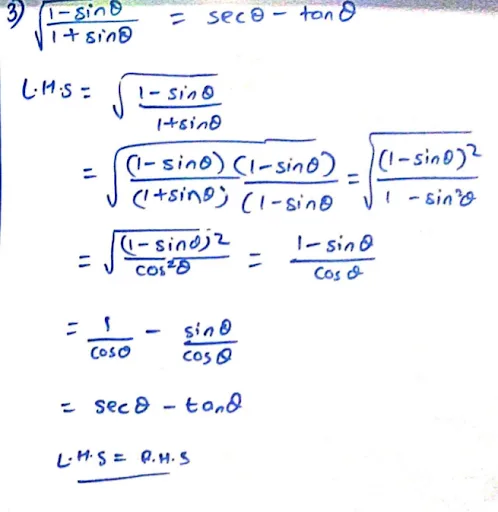
Answer: \(\sqrt{\dfrac{1-\sin\theta}{1+\sin\theta}}=\sec\theta-\tan\theta\) is proved below.
LHS \(= \sqrt{\dfrac{1-\sin\theta}{1+\sin\theta}}\)
Multiply the numerator and denominator inside the root by \((1-\sin\theta)\):
\(= \sqrt{\dfrac{(1-\sin\theta)(1-\sin\theta)}{(1+\sin\theta)(1-\sin\theta)}} = \sqrt{\dfrac{(1-\sin\theta)^2}{1-\sin^2\theta}}\)
\(= \sqrt{\dfrac{(1-\sin\theta)^2}{\cos^2\theta}}\) (since \(1-\sin^2\theta=\cos^2\theta\))
\(= \dfrac{1-\sin\theta}{\cos\theta}\) (for acute \(\theta\), \(1-\sin\theta\) and \(\cos\theta\) are positive)
\(= \dfrac{1}{\cos\theta}-\dfrac{\sin\theta}{\cos\theta} = \sec\theta-\tan\theta\) = RHS
\(\therefore \sqrt{\dfrac{1-\sin\theta}{1+\sin\theta}}=\sec\theta-\tan\theta\).
Answer: \(\sqrt{\dfrac{1-\sin\theta}{1+\sin\theta}} = \sec\theta - \tan\theta\) (proved below).
Multiply the numerator and denominator inside the root by \((1-\sin\theta)\):
\[\text{LHS} = \sqrt{\frac{(1-\sin\theta)^{2}}{(1+\sin\theta)(1-\sin\theta)}}\]
\[= \sqrt{\frac{(1-\sin\theta)^{2}}{1-\sin^{2}\theta}} = \sqrt{\frac{(1-\sin\theta)^{2}}{\cos^{2}\theta}}\]
Since \(1-\sin\theta \ge 0\) (and \(\theta\) is taken as an acute angle, so \(\cos\theta > 0\)):
\[= \frac{1-\sin\theta}{\cos\theta}\]
\[= \frac{1}{\cos\theta} - \frac{\sin\theta}{\cos\theta} = \sec\theta - \tan\theta = \text{RHS}\]
Hence proved.
Practise this chapter
Log in or create a free account to answer this question.