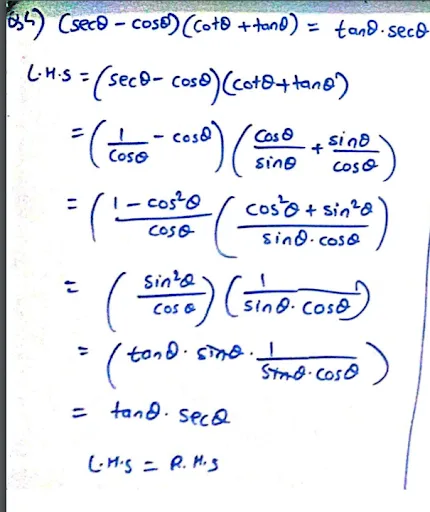
Answer: \((\sec\theta-\cos\theta)(\cot\theta+\tan\theta)=\tan\theta\cdot\sec\theta\) is proved below.
\(\sec\theta-\cos\theta = \dfrac{1}{\cos\theta}-\cos\theta = \dfrac{1-\cos^2\theta}{\cos\theta} = \dfrac{\sin^2\theta}{\cos\theta}\) ...(i)
\(\cot\theta+\tan\theta = \dfrac{\cos\theta}{\sin\theta}+\dfrac{\sin\theta}{\cos\theta} = \dfrac{\cos^2\theta+\sin^2\theta}{\sin\theta\cos\theta} = \dfrac{1}{\sin\theta\cos\theta}\) ...(ii)
LHS \(= \dfrac{\sin^2\theta}{\cos\theta}\times\dfrac{1}{\sin\theta\cos\theta}\) [from (i) and (ii)]
\(= \dfrac{\sin\theta}{\cos^2\theta} = \dfrac{\sin\theta}{\cos\theta}\times\dfrac{1}{\cos\theta} = \tan\theta\cdot\sec\theta\) = RHS
\(\therefore (\sec\theta-\cos\theta)(\cot\theta+\tan\theta)=\tan\theta\cdot\sec\theta\).