prove that vi ) 1/secθ−tanθ=secθ+tanθ
prove that vi ) \(\frac{1}{secθ−tanθ}=secθ+tanθ\)
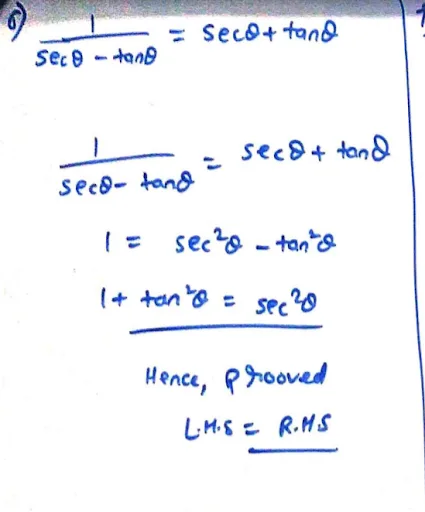
Best answer
Answer: \(\dfrac{1}{\sec\theta-\tan\theta}=\sec\theta+\tan\theta\) is proved below.
LHS \(= \dfrac{1}{\sec\theta-\tan\theta}\)
Multiply numerator and denominator by \((\sec\theta+\tan\theta)\):
\(= \dfrac{\sec\theta+\tan\theta}{(\sec\theta-\tan\theta)(\sec\theta+\tan\theta)} = \dfrac{\sec\theta+\tan\theta}{\sec^2\theta-\tan^2\theta}\)
\(= \dfrac{\sec\theta+\tan\theta}{1}\) (since \(1+\tan^2\theta=\sec^2\theta\), so \(\sec^2\theta-\tan^2\theta=1\))
\(= \sec\theta+\tan\theta\) = RHS
\(\therefore \dfrac{1}{\sec\theta-\tan\theta}=\sec\theta+\tan\theta\).

Answer: \(\dfrac{1}{\sec\theta - \tan\theta} = \sec\theta + \tan\theta\) (proved below).
Multiply the numerator and denominator by \((\sec\theta + \tan\theta)\):
\[\text{LHS} = \frac{\sec\theta + \tan\theta}{(\sec\theta - \tan\theta)(\sec\theta + \tan\theta)}\]
\[= \frac{\sec\theta + \tan\theta}{\sec^{2}\theta - \tan^{2}\theta}\]
Using the identity \(\sec^{2}\theta - \tan^{2}\theta = 1\):
\[= \frac{\sec\theta + \tan\theta}{1} = \sec\theta + \tan\theta = \text{RHS}\]
Hence proved.
Practise this chapter
Log in or create a free account to answer this question.