Skip to content
doubtly

2 answers

Best answer

Answer: \(\dfrac{\tan\theta}{\sec\theta-1}=\dfrac{\tan\theta+\sec\theta+1}{\tan\theta+\sec\theta-1}\) is proved below.

Two fractions are equal if the products of their cross terms are equal. So we show \(\tan\theta(\tan\theta+\sec\theta-1)=(\sec\theta-1)(\tan\theta+\sec\theta+1)\).

Left product \(= \tan\theta(\tan\theta+\sec\theta-1) = \tan^2\theta+\tan\theta\sec\theta-\tan\theta\) ...(i)

Right product \(= (\sec\theta-1)(\tan\theta+\sec\theta+1)\)

\(= \sec\theta\tan\theta+\sec^2\theta+\sec\theta-\tan\theta-\sec\theta-1\)

\(= \sec\theta\tan\theta+(\sec^2\theta-1)-\tan\theta\)

\(= \tan\theta\sec\theta+\tan^2\theta-\tan\theta\) (since \(\sec^2\theta-1=\tan^2\theta\)) ...(ii)

From (i) and (ii), the two products are equal.

\(\therefore \dfrac{\tan\theta}{\sec\theta-1}=\dfrac{\tan\theta+\sec\theta+1}{\tan\theta+\sec\theta-1}\).

image

Doubtly · 30 Sep 2021 Report
Was this answer helpful?

Answer: \(\dfrac{\tan\theta}{\sec\theta - 1} = \dfrac{\tan\theta + \sec\theta + 1}{\tan\theta + \sec\theta - 1}\) (proved below).
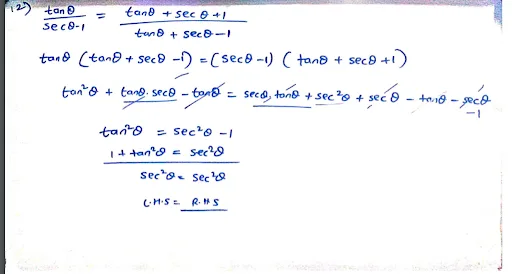
Two fractions are equal if their cross products are equal. So it is enough to show

\[\tan\theta(\tan\theta + \sec\theta - 1) = (\sec\theta - 1)(\tan\theta + \sec\theta + 1)\]

Left side:

\[\tan^{2}\theta + \tan\theta\sec\theta - \tan\theta\]

Right side: expand the product.

\[\sec\theta\tan\theta + \sec^{2}\theta + \sec\theta - \tan\theta - \sec\theta - 1\]

\[= \sec\theta\tan\theta + (\sec^{2}\theta - 1) - \tan\theta\]

Using \(\sec^{2}\theta - 1 = \tan^{2}\theta\):

\[= \tan^{2}\theta + \tan\theta\sec\theta - \tan\theta\]

Both sides are equal, so

\[\frac{\tan\theta}{\sec\theta - 1} = \frac{\tan\theta + \sec\theta + 1}{\tan\theta + \sec\theta - 1}\]

Hence proved.

Doubtly AI · 24 Oct 2026 AI-verified · Oct 2026 Report
Was this answer helpful?

Practise this chapter

Trigonometry

Take the chapter test 10 questions · 15 min · free

Your answer

Log in or create a free account to answer this question.