2 answers
Best answer
Answer: Height of the second building = \(10+12\sqrt3\) m ≈ 30.78 m.
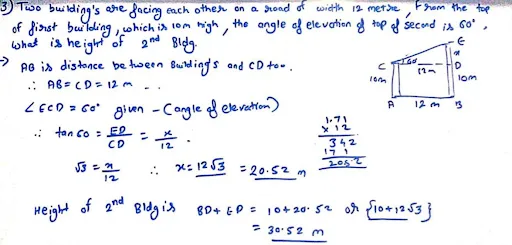
Let AB be the first building (AB = 10 m) and CD the second building, standing on the opposite sides of the road, so BD = 12 m.
Draw AE ⊥ CD from the top A of the first building. Then ABDE is a rectangle, so AE = BD = 12 m and ED = AB = 10 m.
The angle of elevation of C from A is ∠CAE = 60°.
In right-angled ∆AEC,
\(\tan 60^\circ = \dfrac{CE}{AE}\)
\(\therefore \sqrt3 = \dfrac{CE}{12}\)
\(\therefore CE = 12\sqrt3\) m \(= 12\times 1.732 = 20.784\) m
Height of the second building \(CD = CE + ED = 12\sqrt3 + 10\) m
\(\approx 20.784 + 10 = 30.784 \approx 30.78\) m.
\(\therefore\) the second building is \((10+12\sqrt3)\) m, i.e. about 30.78 m high.

Answer: The second building is \(10 + 12\sqrt{3} \approx 30.76\) m high.
Let AB be the first building (A at the top, AB = 10 m) and CD the second building (D at the top). The road width BC = 12 m.
Draw AE parallel to the road from A to meet CD at E. Then AE = BC = 12 m and EC = AB = 10 m.
The angle of elevation of D from A is \(\angle DAE = 60^\circ\). In right \(\triangle AED\):
\[\tan 60^\circ = \frac{DE}{AE}\]
\[\sqrt{3} = \frac{DE}{12} \;\Rightarrow\; DE = 12\sqrt{3}\ \text{m}\]
Height of the second building:
\[CD = DE + EC = 12\sqrt{3} + 10\]
Taking \(\sqrt{3} = 1.73\): \(12 \times 1.73 = 20.76\), so
\[CD = 20.76 + 10 = 30.76\ \text{m}\]
Practise this chapter
Your answer
Log in or create a free account to answer this question.