Skip to content
doubtly

3 answers

Best answer

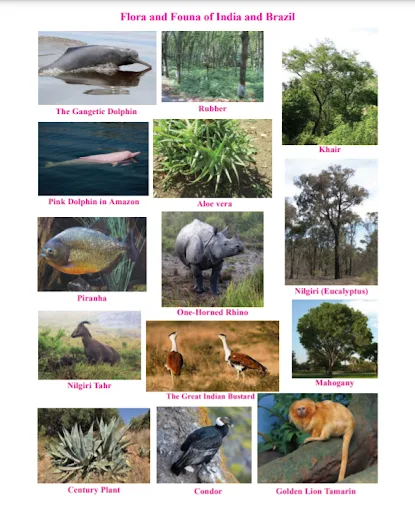
Answer: Flora and fauna of India and Brazil

Flora (natural vegetation):

IndiaBrazil
Teak, sal and sandalwood (tropical deciduous forests)Pau Brasil (brazilwood)
Rosewood, ebony, mahogany (evergreen forests of the Western Ghats and North-East)Rubber tree, mahogany and rosewood
Sundari (mangrove forests of the Sundarbans)Brazil nut tree and acai palm
Deodar, pine, fir (Himalayan forests)Orchids, ferns and climbers in the Amazon forests
Babul, cactus and thorny bushes (dry regions)Grasses and shrubs of the Campos and thorny bushes of the north-east

Fauna (wildlife):

IndiaBrazil
Tiger, Asiatic lion, leopardJaguar, puma
Elephant, one-horned rhinocerosGolden lion tamarin, howler monkey, capybara
Peacock and many other birdsToucan, macaw, parrots
Python, cobra, gharial and crocodileAnaconda, caiman
Deer, wild ass, camel (desert)Piranha and other fresh-water fish of the Amazon

image

Doubtly · 26 Oct 2021 Report
Was this answer helpful?

Answer: Flora and fauna of India and Brazil

Flora of India and Brazil:

IndiaBrazil
Neem treePau Brasil (brazilwood)
Mango treeBrazil nut tree
Teak treeAcai palm
SandalwoodRubber tree
Sundari (mangroves)Rosewood

Fauna of India and Brazil:

IndiaBrazil
Indian peafowlToucan
Indian pythonJaguar
GharialCapybara
Indian bullfrogHowler monkey
Bengal tigerScarlet macaw
Doubtly · 15 Sep 2023 Report
Was this answer helpful?

Answer: Both India and Brazil have very rich biodiversity, but Brazil is dominated by the Amazon rainforest, while India has a wider variety of vegetation types because of its varied relief and climate.

Flora (natural vegetation)

  • Brazil: dense equatorial rainforests (selvas) of the Amazon basin with trees like mahogany, rosewood, rubber and Brazil nut; tropical grasslands (campos) on the Brazilian highlands; thorny scrub and bushes in the dry north-east; coniferous (Araucaria/pine) forests in the cooler south.
  • India: tropical evergreen forests (Western Ghats, North-East), tropical deciduous forests with teak and sal, thorny bushes in dry Rajasthan and Gujarat, mangroves (sundari) in deltas like the Sundarbans, and Himalayan forests with deodar, pine and fir.

Fauna (wildlife)

  • Brazil: jaguar, sloth, anaconda, capybara, monkeys, toucan, macaw and many other colourful birds, piranha and the Amazon river dolphin.
  • India: tiger, Asiatic lion (Gir), elephant, one-horned rhinoceros, deer, snakes such as the cobra and python, the peacock and many other birds, and the gharial.

Comparison: Brazil's vegetation is mostly evergreen because it lies largely in the equatorial region and gets heavy rainfall, so its forests are among the densest in the world. India's vegetation changes with rainfall and altitude, so it has evergreen, deciduous, thorny, mangrove and alpine types. Both countries face loss of forests and wildlife, so both have national parks and protected areas.

Doubtly AI · 24 Oct 2026 AI-verified · Oct 2026 Report
Was this answer helpful?

Practise this chapter

Tourism, Transport and Communication

Take the chapter test 10 questions · 15 min · free

Your answer

Log in or create a free account to answer this question.