Skip to content
doubtly
Topic: Force on current-carrying conductor, force between parallel currents· Magnetic Effects of Current and Magnetism

A square loop ABCD carrying a current i, is placed near and coplanar with a long straight conductor XY carrying a current I, the net force on the loop will be :
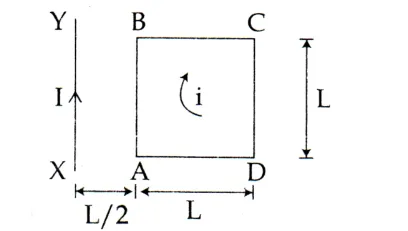
A square loop ABCD carrying a current i, is placed near and coplanar with a long straight conductor XY carrying a current I, the net force on the loop will be :

square loop ABCD near long wire XY with distances L/2 and L

1. \(\frac{2\mu_0 Ii}{3\pi}\)

2. \(\frac{\mu_0 Ii}{2\pi}\)

3. \(\frac{2\mu_0 IiL}{3\pi}\)

4. \(\frac{\mu_0 IiL}{2\pi}\)

1 answer

Best answer

Answer: 1. \(\frac{2\mu_0 Ii}{3\pi}\)

Key idea: forces on the two sides parallel to the wire add up; forces on the other two sides cancel.

  1. Side nearest the wire (distance \(L/2\)): \(F_1=\dfrac{\mu_0 I i L}{2\pi (L/2)}=\dfrac{\mu_0 I i}{\pi}\) (repulsive, since currents are opposite).
  2. Far side (distance \(3L/2\)): \(F_2=\dfrac{\mu_0 I i L}{2\pi (3L/2)}=\dfrac{\mu_0 I i}{3\pi}\) (attractive).
  3. The forces on the two perpendicular sides are equal and opposite.
  4. Net force \(=F_1-F_2=\dfrac{2\mu_0 I i}{3\pi}\).

Options 3 and 4 carry an extra \(L\), so the dimensions are wrong.

Doubtly AI · 30 Oct 2026 AI-generated · not yet verified Report
Was this answer helpful?

Your answer

Log in or create a free account to answer this question.