Skip to content
doubtly
Topic: Force on current-carrying conductor, force between parallel currents· Magnetic Effects of Current and Magnetism

An arrangement of three parallel straight wires placed perpendicular to plane of paper carrying same current 'I' along the same direction is shown in Fig. Magnitude of force per unit length on the middle wire 'B' is given by :
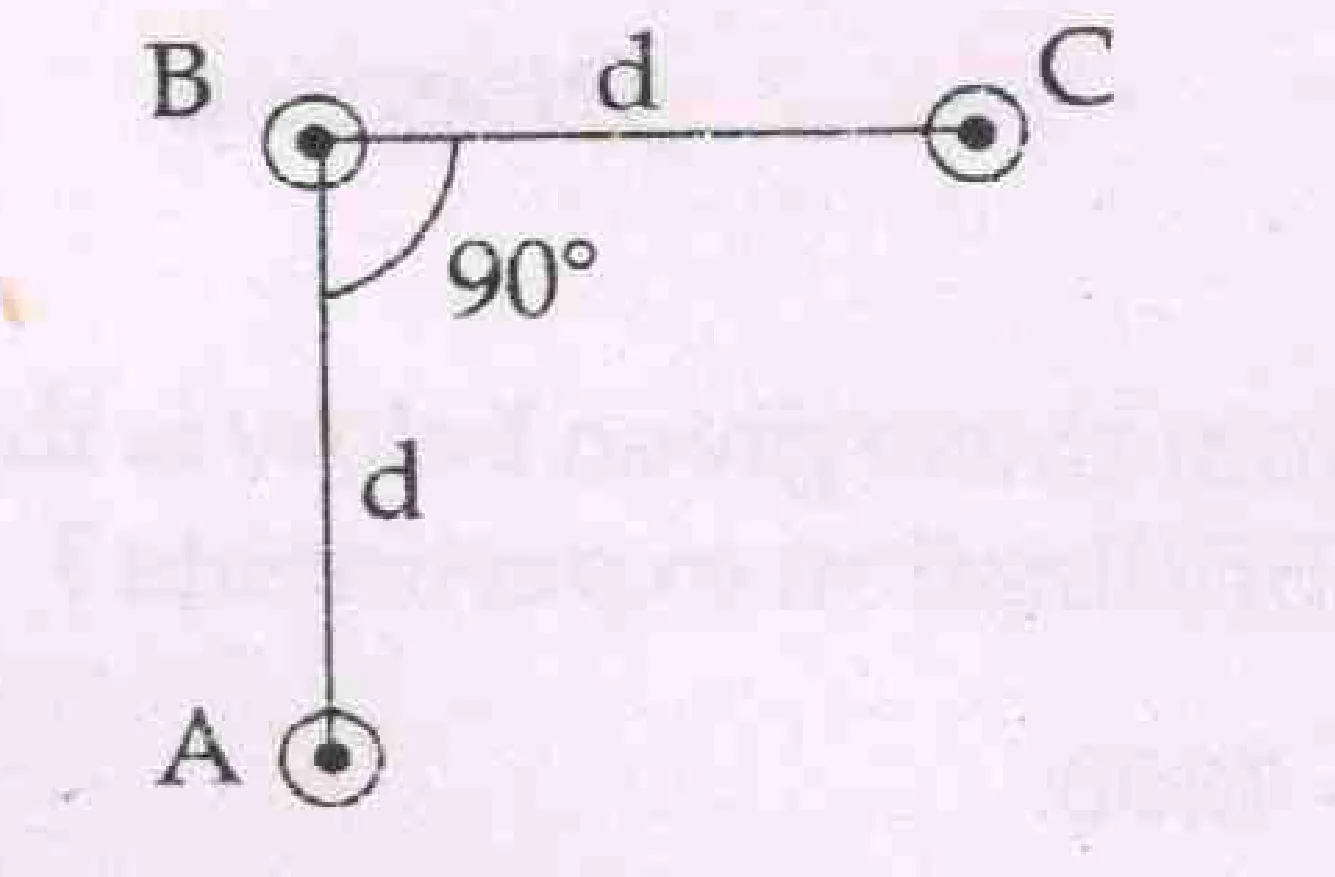
An arrangement of three parallel straight wires placed perpendicular to plane of paper carrying same current 'I' along the same direction is shown in Fig. Magnitude of force per unit length on the middle wire 'B' is given by :

three wires A, B, C with B at the corner, distances d, 90 degrees

1. \(\frac{2\mu_0 i^2}{\pi d}\)

2. \(\frac{\sqrt{2}\mu_0 i^2}{\pi d}\)

3. \(\frac{\mu_0 i^2}{\sqrt{2}\pi d}\)

4. \(\frac{\mu_0 i^2}{2\pi d}\)

1 answer

Best answer

Answer: 3. \(\frac{\mu_0 i^2}{\sqrt{2}\pi d}\)

Key idea: parallel wires carrying current in the same direction attract each other, each pair giving a force per unit length \(\dfrac{\mu_0 i^2}{2\pi d}\).

Wire B is at distance \(d\) from both A (below) and C (right). Force from A on B is directed towards A, force from C on B is towards C. Both have magnitude \(\dfrac{\mu_0 i^2}{2\pi d}\) and are at \(90^\circ\) to each other.

Resultant \(=\sqrt{2}\,\dfrac{\mu_0 i^2}{2\pi d}=\dfrac{\mu_0 i^2}{\sqrt2\,\pi d}\).

Doubtly AI · 30 Oct 2026 AI-generated · not yet verified Report
Was this answer helpful?

Your answer

Log in or create a free account to answer this question.