Skip to content
doubtly
Topic: Electrophilic substitution: halogenation, nitration, Friedel-Crafts· Hydrocarbons

Among the following, the reaction that proceeds through an electrophilic substitution, is :

Among the following, the reaction that proceeds through an electrophilic substitution, is :
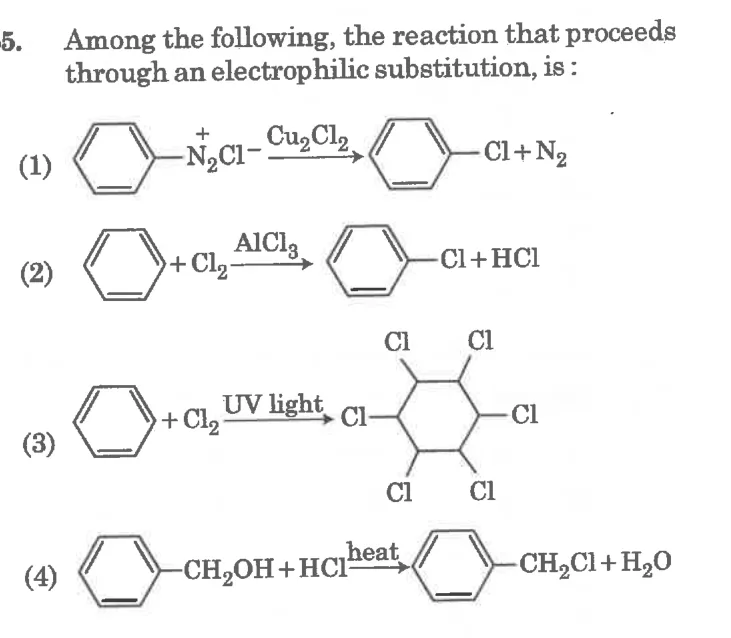
four reaction schemes as options

1. (structure 1, see figure): benzenediazonium chloride \(\xrightarrow{Cu_2Cl_2}\) chlorobenzene + N\(_2\)

2. (structure 2, see figure): benzene + Cl\(_2\) \(\xrightarrow{AlCl_3}\) chlorobenzene + HCl

3. (structure 3, see figure): benzene + Cl\(_2\) \(\xrightarrow{UV\ light}\) hexachlorocyclohexane

4. (structure 4, see figure): benzyl alcohol (C\(_6\)H\(_5\)CH\(_2\)OH) + HCl \(\xrightarrow{heat}\) benzyl chloride + H\(_2\)O

1 answer

Best answer

Answer: 2. (structure 2, see figure): benzene + Cl\(_2\) \(\xrightarrow{AlCl_3}\) chlorobenzene + HCl

  • (1) Sandmeyer reaction: via aryl radical / diazonium, not electrophilic substitution.
  • (2) \(\mathrm{C_6H_6 + Cl_2/AlCl_3}\): \(\mathrm{Cl^+}\) (electrophile) attacks the ring: electrophilic aromatic substitution.
  • (3) \(\mathrm{Cl_2}\) with UV light adds by a free radical mechanism to give benzene hexachloride.
  • (4) Benzyl alcohol with HCl: nucleophilic substitution at the side chain.

Answer: option (2).

Doubtly AI · 30 Oct 2026 AI-generated · not yet verified Report
Was this answer helpful?

Your answer

Log in or create a free account to answer this question.