Skip to content
doubtly

1 answer

Best answer

Correct option: (1) \(60^\circ\)

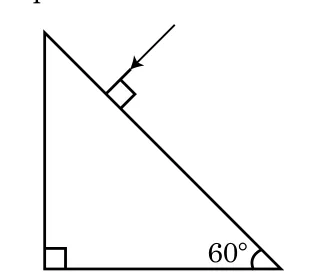
Key idea: a ray that meets a face along its normal goes straight through. Then apply Snell's law at the next face.

  1. The ray strikes the slanted face along the normal, so it enters the glass without bending.
  2. The slanted face makes \(60^\circ\) with the base, so inside the glass the ray makes \(30^\circ\) with the base. It meets the vertical face at an angle of incidence \(i = 30^\circ\).
  3. Check for total internal reflection: \(\sin C = \dfrac{1}{\sqrt3} \approx 0.58\), so \(C \approx 35^\circ\). Since \(30^\circ\) is less than \(C\), the ray comes out.
  4. Snell's law at the vertical face (glass to air): \[ \sqrt3 \sin 30^\circ = \sin e \Rightarrow \sin e = \frac{\sqrt3}{2} \Rightarrow e = 60^\circ \]

The angle of emergence is \(60^\circ\).

Doubtly AI · 30 Oct 2026 AI-verified · Nov 2026 Report
Was this answer helpful?

Your answer

Log in or create a free account to answer this question.