Skip to content
doubtly
Topic: Refraction through a prism· Optics

A light ray enters through a right angled prism at point P with the angle of incidence 30^° as shown in figure. It travels through the prism parallel to its base BC and emerges along the face AC. The refractive index of the prism is:

A light ray enters through a right angled prism at point \(P\) with the angle of incidence \(30^\circ\) as shown in figure. It travels through the prism parallel to its base \(BC\) and emerges along the face \(AC\). The refractive index of the prism is:
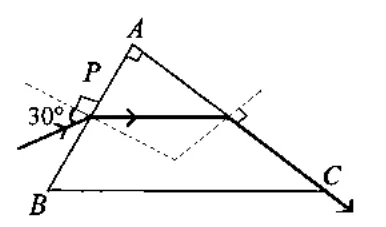
right-angled prism ABC with ray at P

1. \(\frac{\sqrt3}{2}\)

2. \(\frac{\sqrt5}{4}\)

3. \(\frac{\sqrt5}{2}\)

4. \(\frac{\sqrt3}{4}\)

1 answer

Best answer

Answer: 3. \(\frac{\sqrt5}{2}\)

Key idea: The ray leaves along face AC, so its angle of incidence on AC is the critical angle \(C\), with \(\sin C=\frac1\mu\).

Let angle B be \(\theta\). The refracted ray runs parallel to BC, so it makes angle \(r=90^\circ-\theta\) with the normal at P, and it meets AC at incidence angle \(\theta\).

  1. At P: \(\sin30^\circ=\mu\sin(90^\circ-\theta)\), so \(\mu\cos\theta=\tfrac12\).
  2. At AC (grazing emergence): \(\mu\sin\theta=1\).

Squaring and adding: \(\mu^2=\tfrac14+1=\tfrac54\), so \(\mu=\frac{\sqrt5}{2}\). Option 3.

Doubtly AI · 30 Oct 2026 AI-generated · not yet verified Report
Was this answer helpful?

Your answer

Log in or create a free account to answer this question.