Skip to content
doubtly
Topic: Effect of temperature, Arrhenius equation, activation energy· Chemical Kinetics

For a reaction A→B, enthalpy of reaction is -4.2 kJ mol^-1 and enthalpy of activation is 9.6 kJ mol^-1. The correct potential energy profile for the reaction is shown in option.

For a reaction A\(\rightarrow\)B, enthalpy of reaction is \(-4.2\) kJ mol\(^{-1}\) and enthalpy of activation is 9.6 kJ mol\(^{-1}\). The correct potential energy profile for the reaction is shown in option.
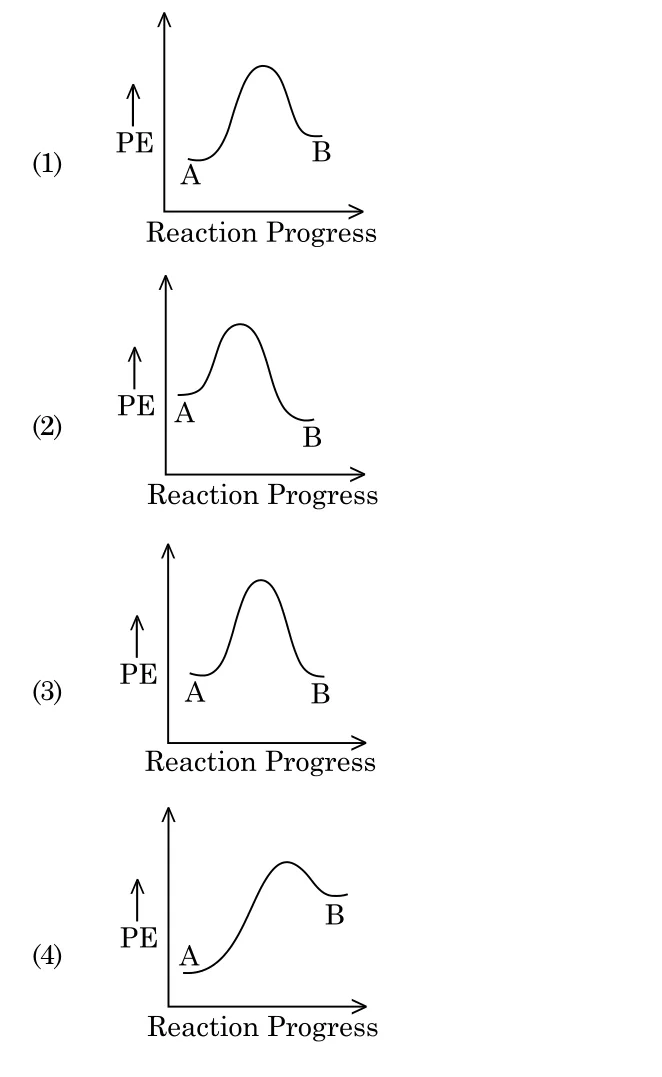
four potential energy (PE) vs Reaction Progress profiles A to B, options 1-4

1. [graph option - see figure]

2. [graph option - see figure]

3. [graph option - see figure]

4. [graph option - see figure]

1 answer

Best answer

Answer: 2. [graph option - see figure]

Key idea: \(\Delta H<0\) means the product B lies below reactant A; activation enthalpy 9.6 kJ/mol means the peak is above A.

Here \(\Delta H=-4.2\) kJ, so the reaction is exothermic with B lower than A, and the barrier height from A is larger (9.6) than the energy drop (4.2).

Options 1 and 4 show B higher than A (endothermic); option 3 shows A and B at nearly the same level. Option 2 shows B lower than A with a peak above A, matching the data.

Doubtly AI · 30 Oct 2026 AI-generated · not yet verified Report
Was this answer helpful?

Your answer

Log in or create a free account to answer this question.