Skip to content
doubtly

1 answer

Best answer

Answer: Total area of the toy = \(273\pi\) cm² = 858 cm² (taking \(\pi=\dfrac{22}{7}\)).

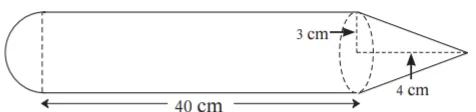
Radius of the hemisphere = radius of the cylinder = radius of the cone = \(r = 3\) cm.

Height of the cone \(h = 4\) cm; height of the cylinder \(H = 40\) cm.

Let the slant height of the cone be \(l\) cm.

\(l = \sqrt{r^2+h^2} = \sqrt{3^2+4^2} = \sqrt{9+16} = \sqrt{25} = 5\) cm.

Total area of the toy = curved surface area of hemisphere + curved surface area of cylinder + curved surface area of cone

\(= 2\pi r^2 + 2\pi rH + \pi rl\)

\(= 2\pi\times 3^2 + 2\pi\times 3\times 40 + \pi\times 3\times 5\)

\(= 18\pi + 240\pi + 15\pi = 273\pi\) cm²

\(= 273\times\dfrac{22}{7} = 39\times 22 = 858\) cm².

Thus, the total area of the toy is \(273\pi\) cm², i.e. 858 cm².

Doubtly · 8 Nov 2021 Report
Was this answer helpful?

Practise this chapter

Mensuration

Take the chapter test 10 questions · 15 min · free

Your answer

Log in or create a free account to answer this question.