Answer: Two types of wet (electrochemical) corrosion are (i) hydrogen evolution type, in acidic medium, where \(\mathrm{2H^++2e^-\rightarrow H_2}\) at the cathode, and (ii) oxygen absorption type, in neutral/alkaline aerated medium, where \(\mathrm{\tfrac12O_2+H_2O+2e^-\rightarrow 2OH^-}\) at the cathode. In both, the anodic metal dissolves: \(\mathrm{Fe\rightarrow Fe^{2+}+2e^-}\).
Wet (electrochemical) corrosion occurs when a metal is in contact with a conducting liquid (moisture or solution). Separate anodic and cathodic areas are formed; only the anodic part corrodes, electrons flow from anode to cathode through the metal, and the corrosion product forms between them.
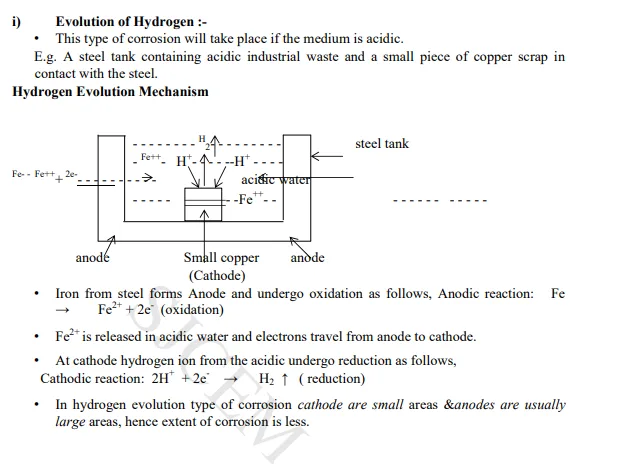
(i) Hydrogen evolution type
- Occurs in acidic media in the absence of oxygen, e.g. iron in contact with acidic industrial solutions.
- Anode (iron): \(\mathrm{Fe\rightarrow Fe^{2+}+2e^-}\) (oxidation; iron dissolves).
- Cathode: the electrons are taken up by hydrogen ions and hydrogen gas is liberated: \(\mathrm{2H^++2e^-\rightarrow H_2\uparrow}\).
- Overall: \(\mathrm{Fe+2H^+\rightarrow Fe^{2+}+H_2\uparrow}\) (e.g. \(\mathrm{Fe+2HCl\rightarrow FeCl_2+H_2}\)).
- Usually the anodic area is large and the cathodic areas are small (e.g. impurities or a less active metal like Cu in contact with Fe).
- Diagram: an iron sheet (anode) dipping in acid solution with small cathodic spots; Fe2+ ions leaving the anode, electrons flowing through the metal to the cathode, and H2 bubbles rising from the cathode.
(ii) Oxygen absorption type
- Occurs in neutral or slightly alkaline aqueous media containing dissolved oxygen, e.g. rusting of iron in NaCl solution or moist air.
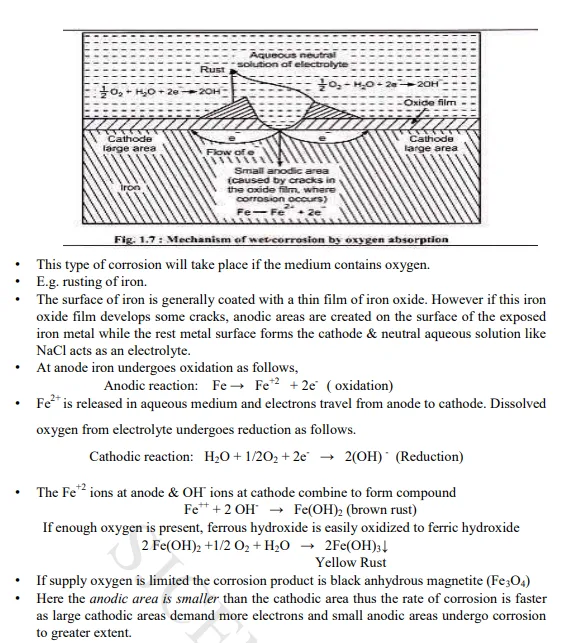
- A crack in the surface oxide film exposes a small area of iron, which becomes the anode; the large film-covered area acts as the cathode.
- Anode: \(\mathrm{Fe\rightarrow Fe^{2+}+2e^-}\).
- Cathode: \(\mathrm{\tfrac12O_2+H_2O+2e^-\rightarrow 2OH^-}\).
- Product: \(\mathrm{Fe^{2+}+2OH^-\rightarrow Fe(OH)_2}\); with excess oxygen \(\mathrm{4Fe(OH)_2+O_2+2H_2O\rightarrow 4Fe(OH)_3}\) (yellow-brown rust, \(\mathrm{Fe_2O_3\cdot xH_2O}\)). With limited oxygen, black magnetite \(\mathrm{Fe_3O_4}\) forms.
- Small anode and large cathode make the attack intense at the anode (pitting).
- Diagram: iron covered by an oxide film with a crack; the crack is the anode, the film-covered surface is the cathode, NaCl solution with dissolved O2 on top, electrons flowing through the metal, and rust deposited between anode and cathode.