Skip to content
doubtly
Chapter: Circle· Mathematics Part 2 (Geometry)

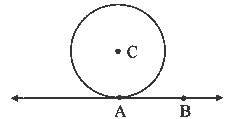
In the adjoining figure, the radius of a circle with centre C is 6 cm, line AB is a tangent at A.

In the adjoining figure, the radius of a circle with centre C is 6 cm, line AB is a tangent at A. Answer the following questions.

i. What is the measure of ∠CAB? Why?

ii. What is the distance of point C from line AB? Why?

iii. d(A, B) = 6 cm, find d(B, C).

iv. What is the measure of ∠ABC? Why?
image

Doubtly Asked Updated Student doubt maths class-10 Save WhatsApp Report

2 answers

Best answer

Answer: i. ∠CAB = 90°; ii. 6 cm; iii. d(B, C) = \(6\sqrt2\) cm ≈ 8.49 cm; iv. ∠ABC = 45°.

i. Line AB is a tangent at A to the circle with centre C, and seg CA is the radius through the point of contact. [Given]

\(\therefore\) ∠CAB = 90° ...(1) [Tangent theorem: a tangent is perpendicular to the radius at the point of contact]

ii. seg CA ⊥ line AB [From (1)]

So the distance of C from line AB is the length of the perpendicular CA, which is the radius.

\(\therefore\) the distance of point C from line AB is 6 cm.

iii. In ∆CAB, ∠CAB = 90° [From (1)]

\(\therefore BC^2 = AB^2 + AC^2\) [Pythagoras theorem]

\(= 6^2 + 6^2 = 36 + 36 = 72\)

\(\therefore BC = \sqrt{72} = \sqrt{36\times 2} = 6\sqrt2\) cm [Taking square root of both sides]

\(\therefore\) d(B, C) = \(6\sqrt2\) cm (≈ 6 × 1.414 ≈ 8.49 cm).

iv. In ∆ABC, seg AC = seg AB = 6 cm

\(\therefore\) ∠ABC = ∠ACB [Isosceles triangle theorem]

Let ∠ABC = ∠ACB = \(x\).

∠CAB + ∠ABC + ∠ACB = 180° [Sum of the measures of the angles of a triangle is 180°]

\(\therefore 90^\circ + x + x = 180^\circ\)

\(\therefore 2x = 90^\circ\), so \(x = 45^\circ\)

\(\therefore\) ∠ABC = 45°.

Doubtly · 9 Jul 2022 Report
Was this answer helpful?

Answer: i. ∠CAB = 90°; ii. 6 cm; iii. d(B, C) = \(6\sqrt2\) cm; iv. ∠ABC = 45°

i. Line AB is a tangent at A and CA is a radius. By the tangent theorem, a tangent is perpendicular to the radius at the point of contact, so ∠CAB = 90°.

ii. Since CA ⊥ AB, the perpendicular distance of C from line AB is CA = radius = 6 cm.

iii. In right-angled △CAB, ∠CAB = 90°. By Pythagoras' theorem,

\[BC^2 = AB^2 + AC^2 = 6^2 + 6^2 = 72\]

\[BC = \sqrt{72} = 6\sqrt2\ \text{cm}\]

So d(B, C) = \(6\sqrt2\) cm (about 8.49 cm).

iv. In △CAB, AB = AC = 6 cm, so ∠ABC = ∠ACB (isosceles triangle theorem). Let each be \(x\). Then

\[90^\circ + x + x = 180^\circ \Rightarrow x = 45^\circ\]

So ∠ABC = 45°.

Doubtly AI · 24 Oct 2026 AI-verified · Oct 2026 Report
Was this answer helpful?

Practise this chapter

Circle

Take the chapter test 10 questions · 15 min · free

Your answer

Log in or create a free account to answer this question.