
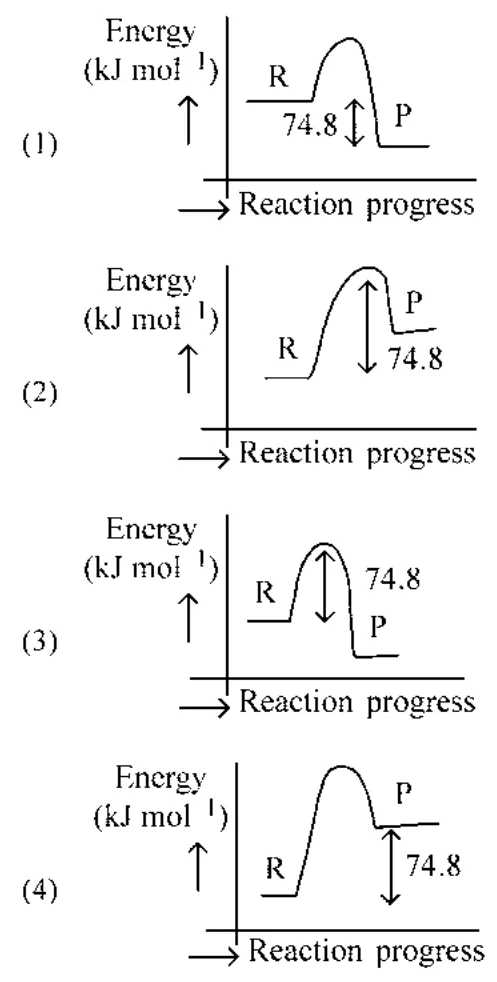
\(\mathrm{C(s) + 2H_2(g) \to CH_4(g)}\); \(\Delta H = -74.8\) kJ \(\mathrm{mol^{-1}}\)
Which of the following diagrams gives an accurate representation of the above reaction? [R \(\to\) reactants; P \(\to\) products]
Every question from past board papers on Hess's law and enthalpies of reactions (bond dissociation, combustion, formation etc.), newest paper first. Open any question for its full worked answer.
\(\mathrm{C(s) + 2H_2(g) \to CH_4(g)}\); \(\Delta H = -74.8\) kJ \(\mathrm{mol^{-1}}\)
Which of the following diagrams gives an accurate representation of the above reaction? [R \(\to\) reactants; P \(\to\) products]
The standard heat of formation, in kcal/mol of \(\mathrm{Ba^{2+}}\) is :
[Given : standard heat of formation of \(\mathrm{SO_4^{2-}}\) ion (aq) = \(-216\) kcal/mol, standard heat of crystallisation of \(\mathrm{BaSO_4}\)(s) = \(-4.5\) kcal/mol, standard heat of formation of \(\mathrm{BaSO_4}\)(s) = \(-349\) kcal/mol]
The bond dissociation energies of X\(_2\), Y\(_2\) and XY are in the ratio of 1 : 0.5 : 1. \(\Delta\)H for the formation of XY is \(-\)200 kJ mol\(^{-1}\). The bond dissociation energy of X\(_2\) will be