
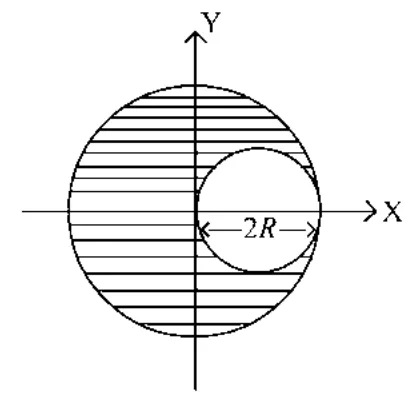
A sphere of radius \(R\) is cut from a larger solid sphere of radius \(2R\) as shown in the figure. The ratio of the moment of inertia of the smaller sphere to that of the rest part of the sphere about the Y-axis is :
Every question from past board papers on Moment of inertia, radius of gyration, MI of simple objects, newest paper first. Open any question for its full worked answer.
A sphere of radius \(R\) is cut from a larger solid sphere of radius \(2R\) as shown in the figure. The ratio of the moment of inertia of the smaller sphere to that of the rest part of the sphere about the Y-axis is :
The moment of inertia of a thin rod about an axis passing through its mid point and perpendicular to the rod is 2400 g cm\(^2\). The length of the 400 g rod is nearly :
The ratio of radius of gyration of a solid sphere of mass \(M\) and radius \(R\) about its own axis to the radius of gyration of the thin hollow sphere of same mass and radius about its axis is :
The ratio of the radius of gyration of a thin uniform disc about an axis passing through its centre and normal to its plane to the radius of gyration of the disc about its diameter is :
From a circular ring of mass 'M' and radius 'R' an arc corresponding to a 90° sector is removed. The moment of inertia of the remaining part of the ring about an axis passing through the centre of the ring and perpendicular to the plane of the ring is 'K' times 'MR\(^2\)'. Then the value of 'K' is :
Three objects, A : (a solid sphere), B : (a thin circular disk) and C : (a circular ring), each have the same mass M and radius R. They all spin with the same angular speed \(\omega\) about their own symmetry axes. The amounts of work (W) required to bring them to rest, would satisfy the relation
From a disc of radius R and mass M, a circular hole of diameter R, whose rim passes through the centre is cut. What is the moment of inertia of the remaining part of the disc about a perpendicular axis, passing through the centre ?
A solid sphere of mass \(m\) and radius \(R\) is rotating about its diameter. A solid cylinder of the same mass and same radius is also rotating about its geometrical axis with an angular speed twice that of the sphere. The ratio of their kinetic energies of rotation (\(E_{sphere}/E_{cylinder}\)) will be
A light rod of length \(l\) has two masses \(m_1\) and \(m_2\) attached to its two ends. The moment of inertia of the system about an axis perpendicular to the rod and passing through the centre of mass is