
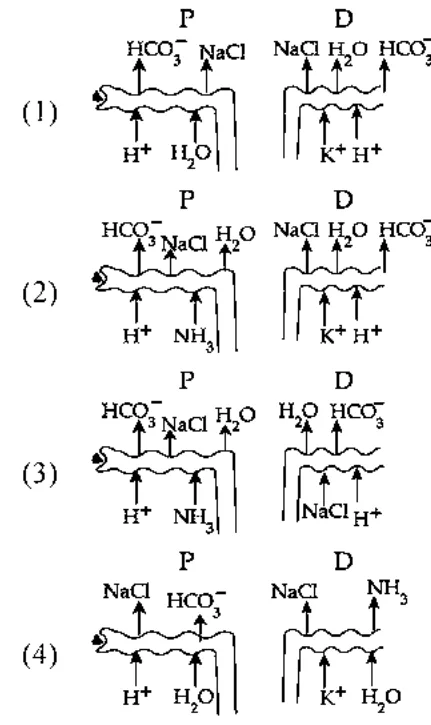
Which of the following diagrams is correct with regard to the proximal (P) and distal (D) tubule of the Nephron.
Every question from past board papers on Excretion: modes, nephron, urine formation, osmoregulation, newest paper first. Open any question for its full worked answer.
Which of the following diagrams is correct with regard to the proximal (P) and distal (D) tubule of the Nephron.
Given below are two statements :
Statement I : In the nephron, the descending limb of loop of Henle is impermeable to water and permeable to electrolytes.
Statement II : The proximal convoluted tubule is lined by simple columnar brush border epithelium and increases the surface area for reabsorption.
In the light of the above statements, choose the correct answer from the options given below :
Choose the correct statement given below regarding juxta medullary nephron.
Given below are statements: one is labelled as Assertion A and the other is labelled as Reason R.
Assertion A: Nephrons are of two types: Cortical & Juxta medullary, based on their relative position in cortex and medulla.
Reason R: Juxta medullary nephrons have short loop of Henle whereas, cortical nephrons have longer loop of Henle.
In the light of the above statements, choose the correct answer from the options given below:
Nitrogenous waste is excreted in the form of pellet or paste by :
Match the items given in Column I with those in Column II and select the correct option given below :
Column I (Function) | Column II (Part of Excretory System)
a. Ultrafiltration | i. Henle's loop
b. Concentration of urine | ii. Ureter
c. Transport of urine | iii. Urinary bladder
d. Storage of urine | iv. Malpighian corpuscle
| v. Proximal convoluted tubule
Which of the following statements is correct ?
In mammals, which blood vessel would normally carry largest amount of urea ?
The part of nephron involved in active reabsorption of sodium is