Skip to content
doubtly

MU FE Sem 1 Basic Electrical and Electronics Engineering Most Important Questions with Solutions (Winter 2026)

Practice set · 3 hrs 24 min · 102 marks · for MU Engineering and similar exams

2026, Winter 2026 204 minutes 102 marks Save WhatsApp

Sections

DC Circuits 5 Q
AC Circuits 5 Q
Single Phase Transformer 3 Q
Electrical Machines 3 Q
Special Purpose Diodes 2 Q
Introduction to Transistors 2 Q

What this set is

This is an original Doubtly set of 20 most important questions for the Mumbai University FE Semester 1 Basic Electrical and Electronics Engineering (ESC102, NEP 2020 scheme, introduced in 2024-25) exam in Winter 2026. It is not an official university paper and does not predict the actual paper. Questions are grouped by module. Each one has a full model answer with steps, units and checks, and carries the marks (3, 4, 5, 6 or 10) that the same type of question carries in recent MU papers.

How the questions were chosen

We went through the last three BEE papers (December 2024, June 2025 KT and December 2025) and listed the question type behind every sub-question. Almost every type came again in the next paper, often with the same marks, for example the 10-mark network theorem and the 10-mark single-phase AC numerical in Q.2 and Q.3. For each repeated type we wrote fresh questions with new values. Per module, at most one question is taken as-is from those papers, and its stem says which paper it came from.

Module and question typeDec 2024June 2025 KTDec 2025
DC: 10-mark network theorem (Superposition / Thevenin / Norton)SuperpositionNortonThevenin, Norton
DC: Nodal analysisYesYesYes
DC: Star–delta transformationYesYesNo
DC: Maximum power transferYesNoYes
AC: 10-mark series circuit numericalYesYesYes
AC: Three-phase star load numericalYesYesYes
AC: Resonance (condition, definitions, comparison)YesYesYes
AC: Parallel branches (admittance, branch currents)YesNoYes
Transformer: working principle, EMF equation / ratioYesYesYes
Transformer: losses / efficiency / ideal vs practicalYesYesYes
Machines: three-phase induction motor principleYesYesNo
Machines: BLDC motorYesYesYes
Machines: DC motor parts / back EMFYesYesYes
Diodes: Zener characteristics and regulatorYesYesYes
Diodes: LED working / applicationsYesYesYes
Transistors: BJT as amplifier / switch / CE characteristicsYesYesYes
Transistors: BJT vs FET, FET noteYesYesYes

A few smaller topics also appeared once or twice and are worth a quick revision from notes: source transformation, the single-phase induction motor (short note and comparison with three-phase), and delta-connection relations for three-phase loads.

How to use this set

Solve each numerical on paper first, at the exam pace of about 2 minutes per mark (the real paper is 60 marks in 2 hours), then check your working against the solution. For circuit questions, redraw the circuit from the description, mark node voltages or loop currents, and always write the final answer with its unit and direction. For theory questions, the model answers show the points and labelled diagram that examiners look for. All numerical results were rechecked by calculation.

FAQs

Will these exact questions come in the Winter 2026 exam?

No one can promise that. These are the question types that repeated most in the last three papers, so they are the best place to start, but cover the whole syllabus.

What is the BEE paper pattern?

The recent papers are 60 marks in 2 hours. Q.1 is compulsory with five 3-mark short questions spread across the modules. Q.2 to Q.6 carry 15 marks each (for example a 10-mark numerical plus a 5-mark theory question), and you answer any three of them.

Why are some questions marked "asked in MU"?

For each module, one question that the university has already set is included word for word so you can see the exact exam wording. All the others are new questions of the same type.
Chapters covered

Instructions

Solve on paper with a timer, then check against the solutions.

DC Circuits

  1. Q.1 Write the formulas for delta-to-star and star-to-delta transformation. Using them, convert a delta network with \(R_{AB}=3\ \Omega\), \(R_{BC}=6\ \Omega\) and \(R_{CA}=9\ \Omega\) into an equivalent star.

    3 marks See answer →
  2. Q.2 State and prove the Maximum Power Transfer theorem. Derive the formula of maximum power delivered. (asked in MU Dec 2024)

    5 marks See answer →
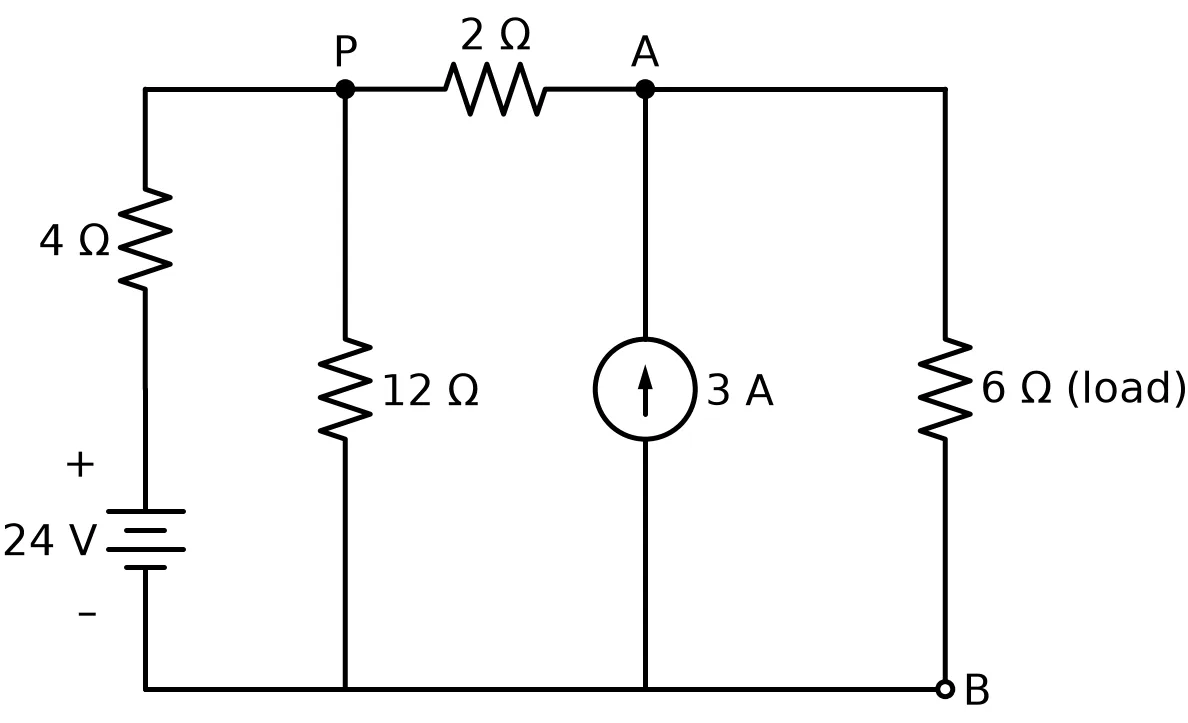
  3. Q.3 Using Thevenin's theorem, find the current through the 6 Ω load resistor in the circuit described below.

    Circuit: a common bottom wire (reference, terminal B). Left branch: a 24 V battery (positive terminal at the top) in series with a 4 Ω resistor, going up from the bottom wire to node P. From P a 12 Ω resistor goes down to the bottom wire. From P a 2 Ω resistor runs right along the top wire to node A. At A, a 3 A current source is connected between the bottom wire and A, with its arrow pointing up (current delivered into A). The 6 Ω load is connected between A and the bottom wire.

    10 marks See answer →
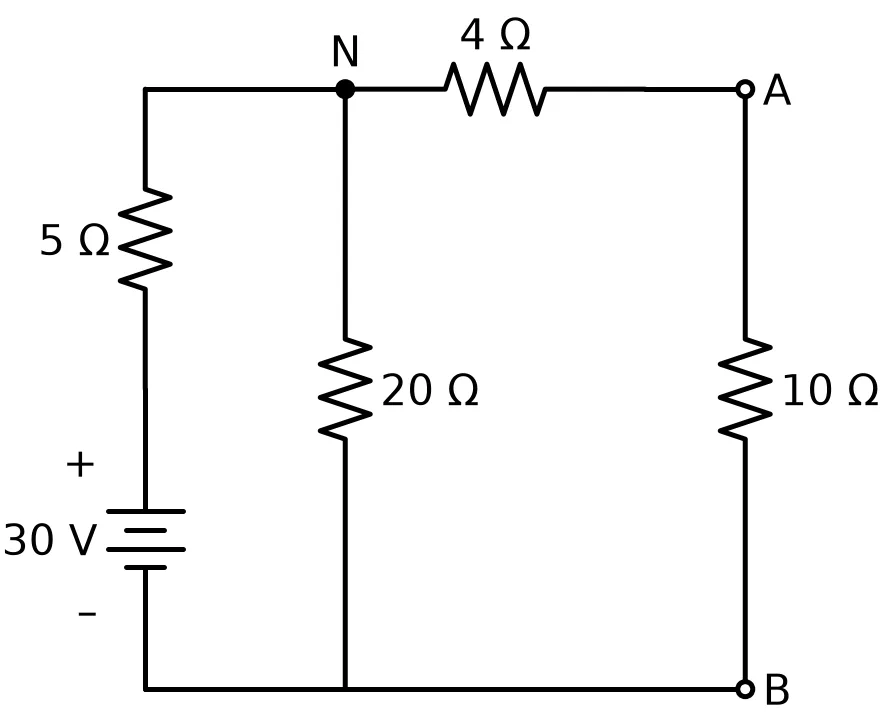
  4. Q.4 Determine the Norton equivalent of the network at terminals A–B and hence find the current through a 10 Ω resistor connected across A–B.

    Circuit: a common bottom wire ending at terminal B. Left branch: a 30 V battery (positive at the top) in series with a 5 Ω resistor, from the bottom wire up to node N. From N a 20 Ω resistor goes down to the bottom wire. From N a 4 Ω resistor runs right to terminal A. The 10 Ω load is connected between A and B.

    6 marks See answer →
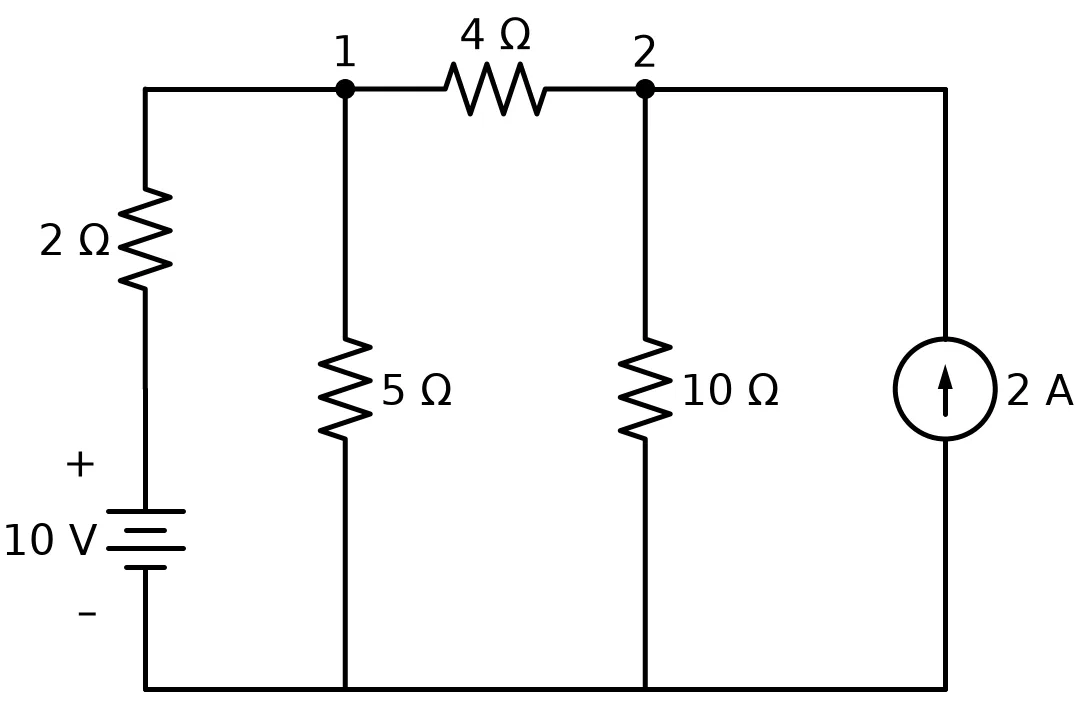
  5. Q.5 Using nodal analysis, find the current through the 4 Ω resistor.

    Circuit: a common bottom wire (reference). Left branch: a 10 V battery (positive at the top) in series with a 2 Ω resistor, from the bottom wire up to node 1. From node 1 a 5 Ω resistor goes down to the bottom wire. Between node 1 and node 2 (top wire) is the 4 Ω resistor. From node 2 a 10 Ω resistor goes down to the bottom wire. At the right, a 2 A current source is connected between the bottom wire and node 2, with its arrow pointing up (current delivered into node 2).

    5 marks See answer →

AC Circuits

  1. Q.6 A sinusoidal voltage of 230 V (RMS), 50 Hz is applied to a circuit. Write the equation for its instantaneous value and find the time taken, measured from the zero crossing (going positive), for the voltage to reach 200 V for the first time.

    3 marks See answer →
  2. Q.7 A series circuit consists of a 20 Ω resistor, a 0.1 H inductor and a 50 μF capacitor connected across a 230 V, 50 Hz supply. Calculate (i) the impedance, (ii) the current and the expression for \(i(t)\), (iii) the power factor, (iv) active, reactive and apparent power, (v) the voltage across each element and (vi) the frequency at which the circuit would resonate.

    10 marks See answer →
  3. Q.8 Two impedances \(Z_1=(6+j8)\ \Omega\) and \(Z_2=(8-j6)\ \Omega\) are connected in parallel across a 200 V, 50 Hz single-phase supply. Find the admittance and current of each branch, the total current, the overall power factor and the total power.

    5 marks See answer →
  4. Q.9 State the condition for resonance in a series RLC circuit. A series circuit has \(R=10\ \Omega\), \(L=0.2\) H and \(C=50\ \mu\)F and is fed from a 100 V variable-frequency supply. Find the resonant frequency, the current at resonance, the quality factor, the bandwidth and the half-power frequencies.

    5 marks See answer →
  5. Q.10 A balanced 3-φ, star connected load consists of three coils each consisting of R = 6 Ω and XL = 8 Ω. Determine the 1) phase impedance 2) phase voltage 3) phase current 4) line current 5) power factor when connected across a 400 V, 50 Hz supply. (asked in MU June 2025 KT)

    5 marks See answer →

Single Phase Transformer

  1. Q.11 Explain the working principle of a single-phase transformer and derive the EMF equation. (asked in MU June 2025 KT)

    6 marks See answer →
  2. Q.12 A 22 kVA, 2200/220 V, 50 Hz single-phase transformer has 1000 turns on its primary. Assuming it to be ideal, find (i) the transformation ratio, (ii) the number of secondary turns, (iii) the maximum flux in the core, (iv) the maximum flux density if the core cross-section is 100 cm², and (v) the full-load primary and secondary currents.

    5 marks See answer →
  3. Q.13 What are the losses in a single-phase transformer? Define its efficiency and state the condition for maximum efficiency.

    3 marks See answer →

Electrical Machines

  1. Q.14 Explain the working principle of a three-phase induction motor and mention its types. (asked in MU June 2025 KT)

    5 marks See answer →
  2. Q.15 Explain the construction and working of a brushless DC (BLDC) motor. List its advantages and applications.

    5 marks See answer →
  3. Q.16 Draw a labelled sketch of a DC motor and state the function of each main part. Explain back EMF. A 220 V DC shunt motor has an armature resistance of 0.5 Ω and draws an armature current of 20 A; find its back EMF.

    4 marks See answer →

Special Purpose Diodes

  1. Q.17 Draw the characteristics of a Zener diode and explain the application of a Zener diode as a voltage regulator. (asked in MU Dec 2025)

    5 marks See answer →
  2. Q.18 Explain the working of an LED and list its applications.

    3 marks See answer →

Introduction to Transistors

  1. Q.19 Compare BJT and FET. (asked in MU Dec 2025; also in June 2025 KT)

    4 marks See answer →
  2. Q.20 With a neat circuit diagram, explain the operation of an NPN transistor as a switch. In such a circuit \(V_{CC}=12\) V, \(R_C=1\) kΩ, \(\beta=100\) and \(V_{CE(sat)}=0.2\) V; find the collector saturation current and the minimum base current needed to saturate the transistor.

    5 marks See answer →