Skip to content
doubtly

1 answer

Best answer

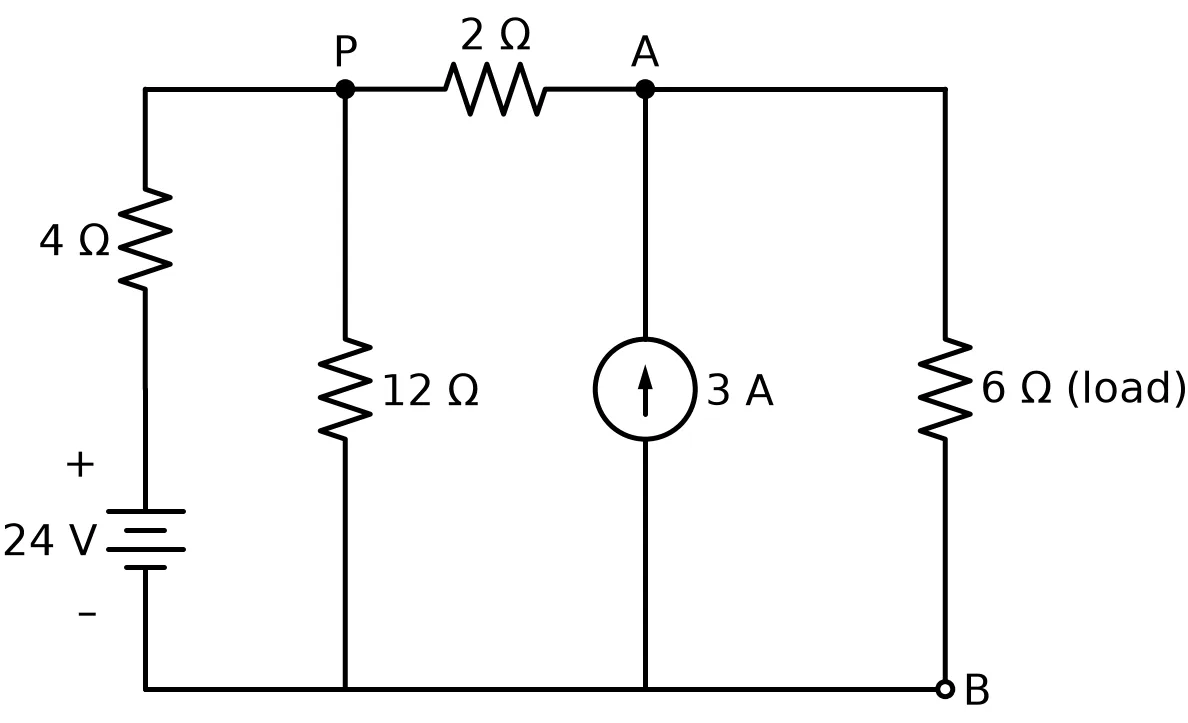
Answer: \(V_{th}=33\) V, \(R_{th}=5\ \Omega\), current through 6 Ω \(=\dfrac{33}{5+6}=3\) A (flowing from A down to B).

Step 1: Remove the 6 Ω load and find the open-circuit voltage \(V_{th}=V_{AB}\).

With A open, the 3 A from the current source has only one path: through the 2 Ω from A to P. So \(V_A-V_P=3\times2=6\) V.

KCL at P (3 A enters from the 2 Ω):

\[\frac{V_P-24}{4}+\frac{V_P}{12}=3\ \Rightarrow\ 3V_P-72+V_P=36\ \Rightarrow\ V_P=27\text{ V}.\]

\(V_{th}=V_A=V_P+6=33\) V.

Step 2: Find \(R_{th}\). Short the 24 V source and open the 3 A current source. Looking into A–B:

\[R_{th}=2+(4\parallel12)=2+\frac{4\times12}{4+12}=2+3=5\ \Omega.\]

Step 3: Thevenin equivalent: 33 V in series with 5 Ω, connected to the 6 Ω load.

\[I_L=\frac{V_{th}}{R_{th}+R_L}=\frac{33}{5+6}=3\text{ A}.\]

Check by nodal analysis of the full circuit: with \(V_A=3\times6=18\) V, KCL at A gives \(\frac{V_A-V_P}{2}+\frac{18}{6}=3\Rightarrow V_P=18\) V; KCL at P: \(\frac{18-24}{4}+\frac{18}{12}+\frac{18-18}{2}=-1.5+1.5+0=0\) ✓.

Doubtly AI · 27 Oct 2026 AI-verified · Oct 2026 Report
Was this answer helpful?

Your answer

Log in or create a free account to answer this question.