Using nodal analysis, find the current through the 4 Ω resistor.
Q.5 Using nodal analysis, find the current through the 4 Ω resistor.
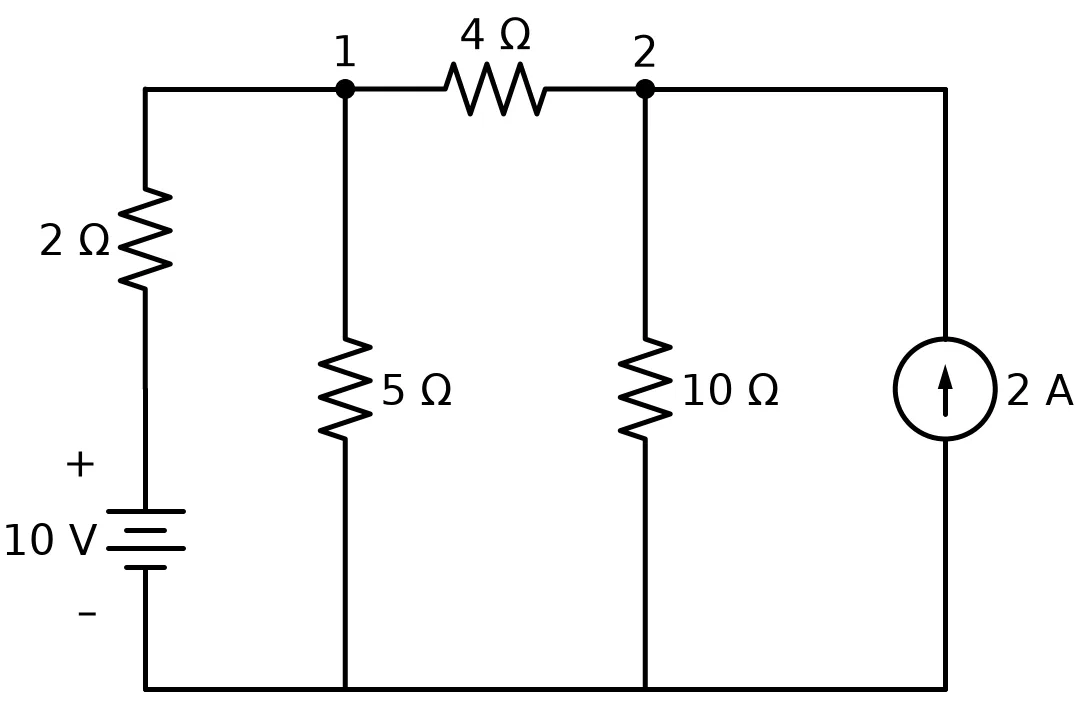
Q.5 Using nodal analysis, find the current through the 4 Ω resistor.

Best answer
Answer: \(V_1=8.33\) V, \(V_2=11.67\) V; current through 4 Ω \(=0.833\) A, flowing from node 2 to node 1.
Take the bottom wire as reference; unknowns \(V_1,V_2\). Write KCL as "sum of currents leaving = 0".
Node 1: \(\dfrac{V_1-10}{2}+\dfrac{V_1}{5}+\dfrac{V_1-V_2}{4}=0\). Multiply by 20: \(10V_1-100+4V_1+5V_1-5V_2=0\Rightarrow 19V_1-5V_2=100\) ...(1)
Node 2 (2 A enters): \(\dfrac{V_2-V_1}{4}+\dfrac{V_2}{10}=2\). Multiply by 20: \(5V_2-5V_1+2V_2=40\Rightarrow -5V_1+7V_2=40\) ...(2)
Solve by Cramer's rule: \(\Delta=19\times7-(-5)(-5)=133-25=108\).
\(V_1=\dfrac{100\times7-(-5)\times40}{108}=\dfrac{900}{108}=8.333\) V, \(V_2=\dfrac{19\times40-(-5)\times100}{108}=\dfrac{1260}{108}=11.667\) V.
\[I_{4\Omega}=\frac{V_2-V_1}{4}=\frac{11.667-8.333}{4}=0.833\text{ A}\ (\text{node 2}\to\text{node 1}).\]
Check at node 2: \(0.833+\frac{11.667}{10}=0.833+1.167=2\) A ✓.
Log in or create a free account to answer this question.