Skip to content
doubtly
Chapter: DC Circuits· Basic Electrical & Electronics Engineering

Determine the Norton equivalent of the network at terminals A–B and hence find the current through a 10 Ω resistor connected across A–B.
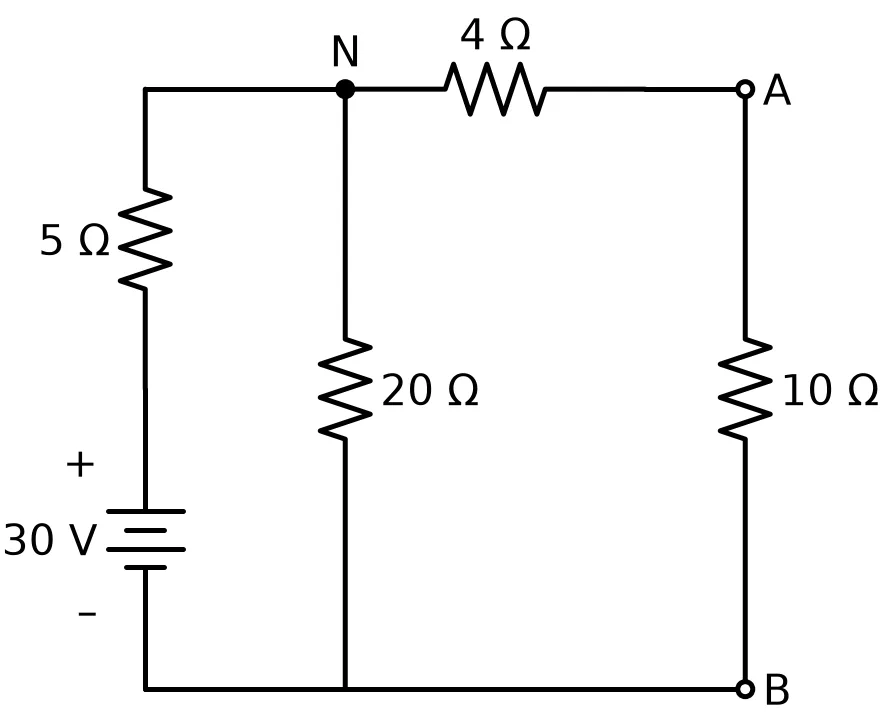
Q.4 Determine the Norton equivalent of the network at terminals A–B and hence find the current through a 10 Ω resistor connected across A–B.

Circuit: a common bottom wire ending at terminal B. Left branch: a 30 V battery (positive at the top) in series with a 5 Ω resistor, from the bottom wire up to node N. From N a 20 Ω resistor goes down to the bottom wire. From N a 4 Ω resistor runs right to terminal A. The 10 Ω load is connected between A and B.

Doubtly AI Asked Updated AI-generated · not yet verified Practice test mu engineering Save WhatsApp Report

1 answer

Best answer

Answer: \(I_N=3\) A, \(R_N=8\ \Omega\); current through 10 Ω \(=3\times\dfrac{8}{8+10}=1.33\) A.

Step 1: Short-circuit current \(I_N\) (short A–B, load removed). The 4 Ω is now in parallel with the 20 Ω:

\(4\parallel20=\dfrac{80}{24}=3.333\ \Omega\). Total resistance seen by the source \(=5+3.333=8.333\ \Omega\).

Source current \(=\dfrac{30}{8.333}=3.6\) A, so \(V_N=3.6\times3.333=12\) V.

\[I_N=I_{sc}=\frac{V_N}{4}=\frac{12}{4}=3\text{ A}.\]

Step 2: Norton resistance (short the 30 V source, look into A–B):

\[R_N=4+(5\parallel20)=4+\frac{100}{25}=8\ \Omega.\]

Step 3: Norton equivalent: 3 A current source in parallel with 8 Ω. Connect 10 Ω across A–B; by current division

\[I_{10}=I_N\frac{R_N}{R_N+R_L}=3\times\frac{8}{18}=1.33\text{ A}.\]

Check with Thevenin: \(V_{th}=I_NR_N=24\) V \((=30\times\frac{20}{25})\), \(I=\frac{24}{8+10}=1.33\) A ✓.

Doubtly AI · 27 Oct 2026 AI-verified · Oct 2026 Report
Was this answer helpful?

Your answer

Log in or create a free account to answer this question.