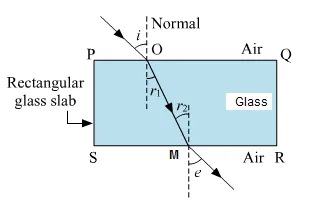
Answer: Using Snell's law at both surfaces of the slab and the fact that the two refraction angles inside the slab are equal, \(\sin i = \sin e\), so \(i = e\).
Setting: A ray PQ falls on the upper surface of a rectangular glass slab at Q with angle of incidence \(i\). It is refracted along QR inside the glass at angle of refraction \(r_1\). At R on the lower surface it meets the surface at angle of incidence \(r_2\) and emerges into air along RS at angle of emergence \(e\). Let \(n\) be the refractive index of glass with respect to air.
Proof:
At the first surface (air to glass), by Snell's law:
\(\dfrac{\sin i}{\sin r_1} = n\) ... (i)
At the second surface (glass to air):
\(\dfrac{\sin r_2}{\sin e} = \dfrac{1}{n}\) ... (ii)
The two faces of the slab are parallel, so the normals at Q and R are parallel. QR is a transversal cutting them, so \(r_1\) and \(r_2\) are alternate angles:
\(r_1 = r_2\) ... (iii)
Using (iii) in (i): \(\dfrac{\sin i}{\sin r_2} = n\) ... (iv)
Multiplying (ii) and (iv):
\(\dfrac{\sin i}{\sin r_2} \times \dfrac{\sin r_2}{\sin e} = n \times \dfrac{1}{n} = 1\)
\(\therefore \sin i = \sin e \Rightarrow i = e\)
Hence the emergent ray RS is parallel to the incident ray PQ (it is only laterally shifted).