
Q.1 (A)(v) The angle between the surface of a glass slab and incident ray is 30º. The angle of incidence is ........................
Refraction of Light
Chapter 6: Refraction of light
Every question from past board papers on Refraction of Light, newest paper first. Open any question for its full worked answer.
Maharashtra SSC Science and Technology Part 1 Board Paper June 2026
Full paper →-
-
Q.2 (A)(i) Give scientific reasons : Stars appear to be higher in the sky as compared to its actual position.
-
Q.3 (vii) Observe the following diagrams and state the rules of refraction of light in different media using it.
[Three diagrams: (a) a ray passing from a rarer medium (air) into a denser medium (glass) and bending towards the normal; (b) a ray passing from a denser medium into a rarer medium and bending away from the normal; (c) a ray falling normally on the surface between a rarer and a denser medium and going straight on.]
Maharashtra SSC Science and Technology Part 1 Board Paper March 2026
Full paper →-
Q.1 (A)(iv) The refractive index of diamond is ........................ .
-
Q.1 (B)(v) What is the wavelength of violet ray in dispersion of light ?
-
Q.2 (B)(v) ‘A rainbow is the combined effect of refraction, dispersion and total internal reflection of light’. Explain the sentence.
-
Q.3 (viii) What is meant by ‘mirage’ ? In which condition mirage is seen ? Give such one more example.
Maharashtra SSC Science and Technology Part 1 Board Paper March 2026, Marathi Medium (विज्ञान आणि तंत्रज्ञान भाग १ मार्च 2026)
Full paper →-
प्रश्न 1 (अ)(iv) हिऱ्याचा अपवर्तनांक ...................... आहे.
-
प्रश्न 1 (ब)(v) प्रकाशाच्या अपस्करणात जांभळ्या किरणांची तरंगलांबी किती असते ?
-
प्रश्न 2 (ब)(v) इंद्रधनुष्य हे प्रकाशाचे अपस्करण, अपवर्तन आणि आंतरिक परावर्तन ह्या तीनही नैसर्गिक घटनांचे एकत्रीकरण आहे. हे विधान स्पष्ट करा.
-
प्रश्न 3 (viii) मृगजळ म्हणजे काय ? कोणत्या परिस्थितीत मृगजळ दिसते ? तसेच अशाच प्रकारचे एक उदाहरण लिहा.
Maharashtra SSC Science and Technology Part 1 Board Paper June 2026, Marathi Medium (विज्ञान आणि तंत्रज्ञान भाग १ जून 2026)
Full paper →-
प्रश्न 1 (अ)(v) काचेच्या लादीचा पृष्ठभाग आणि आपाती किरण यांच्यामधील कोनाचे माप 30º आहे. तर आपाती कोनाचे माप ...................... असेल.
-
प्रश्न 2 (अ)(i) तारे आहे त्या स्थितीपेक्षा थोड्या उंचीवर असल्याचे भासतात.
-
प्रश्न 3 (vii) खालील आकृतीचे निरीक्षण करून विविध माध्यमातील प्रकाशाच्या अपवर्तनाचे नियम लिहा :
(आकृती: तीन आकृत्या. (अ) विरल माध्यमातून घन माध्यमात तिरपा जाणारा किरण; आपाती कोन i व अपवर्तन कोन r दाखवले असून किरण स्तंभिकेकडे झुकतो. (ब) घन माध्यमातून विरल माध्यमात तिरपा जाणारा किरण; i व r दाखवले असून किरण स्तंभिकेपासून दूर जातो. (क) विरल माध्यमातून घन माध्यमात पृष्ठभागाला लंब दिशेने जाणारा किरण, जो दिशा न बदलता सरळ जातो.)
Maharashtra SSC Science and Technology Part 1 Board Paper March 2025
Full paper →-
Q.1 (A)(iv) Light changes its direction when going from one transparent medium to another transparent medium. This process is called ......................... .
-
Q.1 (B)(iii) What is the reason for twinkling of stars ?
-
Q.3 (v) Answer the following with respect to the ‘Formation of Rainbow’ :
(a) Draw a neat diagram to show the formation of rainbow.
(b) Name any two natural processes involved in formation of rainbow.
(c) What does a small droplet of water act as ?
Maharashtra SSC Science and Technology Part 1 Board Paper July 2025
Full paper →-
Q.1 (A)(iv) Light changes its direction when going from one transparent medium to another transparent medium. This is called the ................... of light.
-
Q.1 (B)(ii) Complete the co-relation.
Red light wavelength close to : 700 nm : : Violet light wavelength close to : .................... . -
Q.4 (i) “A rainbow is the combined effect of the refraction, dispersion and total internal reflection of light.” Prove this statement with the help of diagram and explain it.
Maharashtra SSC Science and Technology Part 1 Board Paper March 2025, Marathi Medium (विज्ञान आणि तंत्रज्ञान भाग १ मार्च 2025)
Full paper →-
प्रश्न 1 (अ)(iv) एका पारदर्शक माध्यमातून दुसऱ्या पारदर्शक माध्यमात प्रकाश जाताना त्याची मार्गक्रमणाची दिशा बदलते, यालाच प्रकाशाचे ...................... म्हणतात.
-
प्रश्न 1 (ब)(iii) ताऱ्यांच्या लुकलुकण्याचे कारण काय ?
-
प्रश्न 3 (v) इंद्रधनुष्यनिर्मिती या नैसर्गिक सुंदर घटनेसंबंधी खालील प्रश्नांची उत्तरे द्या :
(a) इंद्रधनुष्यनिर्मितीची शास्त्रीयदृष्ट्या अचूक व नामनिर्देशित आकृती काढा.
(b) यात अंतर्भाव असणाऱ्या कोणत्याही दोन नैसर्गिक घटना सांगा.
(c) पाण्याचे अगदी लहान थेंब कशाप्रमाणे कार्य करतात ?
Maharashtra SSC Science and Technology Part 1 Board Paper July 2025, Marathi Medium (विज्ञान आणि तंत्रज्ञान भाग १ जुलै 2025)
Full paper →-
प्रश्न 1 (अ)(iv) प्रकाश एका पारदर्शक माध्यमातून दुसऱ्या पारदर्शक माध्यमात जाताना त्याची मार्गक्रमणाची दिशा बदलते, यालाच प्रकाशाचे ................... असे म्हणतात.
-
प्रश्न 1 (ब)(ii) सहसंबंध पूर्ण करा :
तांबडा किरण तरंगलांबी जवळपास : 700 nm : : जांभळा किरण तरंगलांबी जवळपास : ............. -
प्रश्न 4 (i) इंद्रधनुष्य हे प्रकाशाचे अपस्करण, अपवर्तन आणि आंतरिक परावर्तन ह्या तीनही नैसर्गिक घटनांचे एकत्रीकरण आहे. हे विधान आकृतीसह स्पष्ट करा.
Maharashtra SSC Science and Technology Part 1 Board Paper July 2024
Full paper →-
Q.1 (A)(iv) We can see the sun even when it is little below the horizon because of ........................ .
-
Q.1 (B)(iv) What is angle of refraction when angle of incidence is 0º ?
-
Q.2 (B)(i) The absolute refractive index of water is 1.33. What is the velocity of light in water ?
(Velocity of light in vacuum = 3 × 10⁸ m/s) -
Q.3 (iii) Read the following paragraph and answer the questions given below :
Rainbow is a beautiful natural phenomenon. It is the combined effect of dispersion, refraction and total internal reflection of light. It can be seen mainly after rainfall. Small droplets of water act as small prisms. When light rays from the sun enter these droplets it gets refracted and dispersed. Then there is internal reflection and after that once again the light gets refracted while coming out of the droplet. All these three processes together produce the rainbow.
(a) Which three major phenomena are responsible for rainbow formation ?
(b) How does refraction take place ?
(c) Draw a diagrammatic representation of rainbow production.
Maharashtra SSC Science and Technology Part 1 Board Paper March 2024
Full paper →-
Q.1 (A)(ii) We can see the sun even when it is little below the horizon because of .........................................
-
Q.1 (B)(v) Match the Columns :
Column ‘A’ Column ‘B’ Refractive index of water (a) 1.31
(b) 1.36
(c) 1.33 -
Q.4 (i) Observe the given diagram and answer the questions :
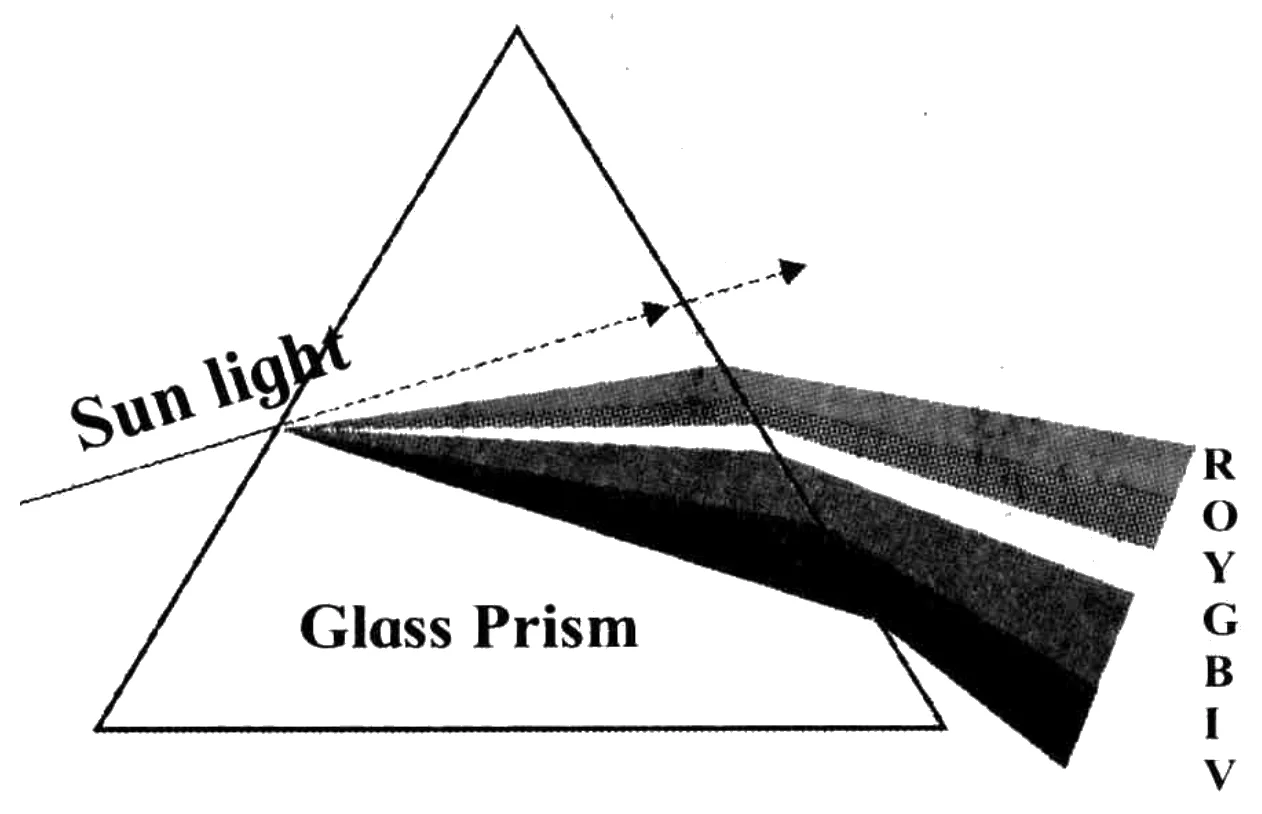
(a) Name the process shown in the figure.
(b) Name the colour that deviates the most.
(c) Name the colour that deviates the least.
(d) Name any one phenomenon in the nature which is based on the above process.
(e) Define ‘spectrum’.
Maharashtra SSC Science and Technology Part 1 Board Paper March 2024, Marathi Medium (विज्ञान आणि तंत्रज्ञान भाग १ मार्च 2024)
Full paper →-
प्रश्न 1 (अ)(ii) सूर्य क्षितिजाच्या थोडा खाली असताना देखील आपल्याला दिसतो याचे कारण :
-
प्रश्न 1 (ब)(v) योग्य जोडी जुळवा :
‘अ’ स्तंभ ‘ब’ स्तंभ पाण्याचा अपवर्तनांक (a) 1.31
(b) 1.36
(c) 1.33 -
प्रश्न 4 (i) खाली दिलेल्या आकृतीचे निरीक्षण करून प्रश्नांची उत्तरे लिहा :
(आकृती: काचेचा त्रिकोणी लोलक; ‘सूर्यप्रकाश’ लोलकाच्या एका पृष्ठावर पडतो, लोलकात अपवर्तित होतो आणि दुसऱ्या पृष्ठातून रंगांच्या पट्ट्याच्या रूपात बाहेर पडतो. पट्ट्यातील रंग वरून खाली R, O, Y, G, B, I, V असे दाखवले आहेत.)
(a) आकृतीत कोणती प्रक्रिया दर्शवली आहे ?
(b) सर्वात जास्त विचलन झालेला रंग कोणता ?
(c) सर्वात कमी विचलन झालेला रंग कोणता ?
(d) वरील प्रक्रियेवर आधारित कोणतीही एक नैसर्गिक घटना लिहा.
(e) व्याख्या लिहा : वर्णपंक्ती.
Maharashtra SSC Science and Technology Part 1 Board Paper July 2024, Marathi Medium (विज्ञान आणि तंत्रज्ञान भाग १ जुलै 2024)
Full paper →-
प्रश्न 1 (अ)(iv) सूर्य क्षितीजाच्या थोड्या खाली असताना देखील आपल्याला दिसतो. याचे कारण :
-
प्रश्न 1 (ब)(iv) आपाती कोन 0º असेल, तर अपवर्ती कोनाचे माप किती ?
-
प्रश्न 2 (ब)(i) पाण्याचा निरपेक्ष अपवर्तनांक 1.33 असल्यास, प्रकाशाचा पाण्यातील वेग किती ?
(प्रकाशाचा निर्वातातील वेग = 3 × 10⁸ m/s) -
प्रश्न 3 (iii) खालील उतारा वाचून दिलेल्या प्रश्नांची उत्तरे लिहा :
इंद्रधनुष्य ही निसर्गातील सुंदर घटना आहे. इंद्रधनुष्य हे प्रकाशाचे अपस्करण, अपवर्तन आणि आंतरिक परावर्तन यांचा एकत्रित परिणाम आहे. प्रामुख्याने पाऊस पडून गेल्यानंतर आकाशात इंद्रधनुष्य दिसते. पाण्याचे अगदी लहान थेंब छोट्या लोलकाप्रमाणे कार्य करतात. जेंव्हा वातावरणातील पाण्याच्या लहान थेंबामध्ये प्रकाश किरण प्रवेश करतात, तेंव्हा पाण्याचे थेंब सूर्यप्रकाशाचे अपवर्तन व अपस्करण घडवून आणतात. नंतर थेंबाच्या आतमध्ये आंतरिक परावर्तन होते आणि त्यानंतर पुन्हा प्रकाशाचे अपवर्तन होते. या सर्व नैसर्गिक घटनांचा एकत्रित परिणाम इंद्रधनुष्य होय.
(अ) इंद्रधनुष्यासाठी कोणत्या तीन घटना आवश्यक आहेत ?
(ब) अपवर्तन कसे घडून येते ?
(क) इंद्रधनुष्य निर्मितीची आकृती रेखाटा.