Skip to content
doubtly
Topic: Electric potential, potential difference, equipotential surfaces· Electrostatics

The diagrams below show regions of equipotentials.A positive charge is moved from A to B in each diagram.

The diagrams below show regions of equipotentials.

A positive charge is moved from A to B in each diagram.
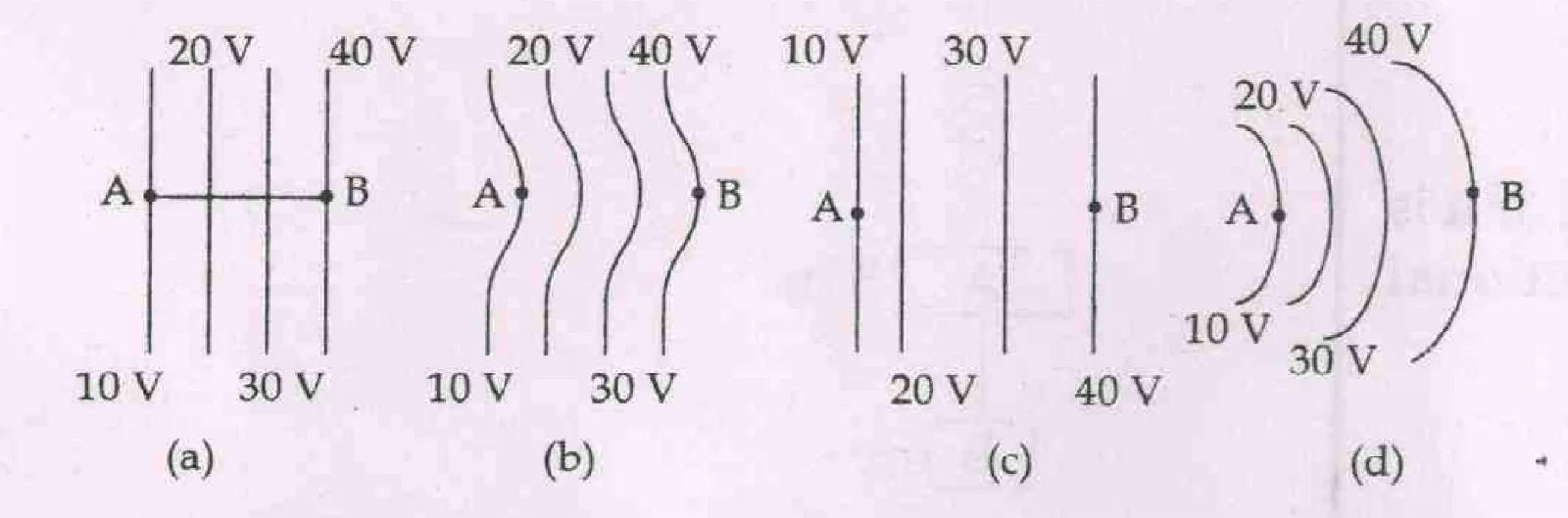
four equipotential diagrams (a)-(d) with points A and B and potentials

1. In all the four cases the work done is the same.

2. Minimum work is required to move q in figure (a).

3. Maximum work is required to move q in figure (b).

4. Maximum work is required to move q in figure (c).

1 answer

Best answer

Answer: 1. In all the four cases the work done is the same.

Key idea: work done by an external agent moving a charge slowly is \(W=q(V_B-V_A)\), which depends only on the end potentials, not on the path or shape of equipotentials.

In all four diagrams A lies on the 10 V surface and B on the 40 V surface, so \(V_B-V_A=30\) V in every case.

Hence work done is the same in all four cases.

Doubtly AI · 30 Oct 2026 AI-generated · not yet verified Report
Was this answer helpful?

Your answer

Log in or create a free account to answer this question.