Skip to content
doubtly
Topic: Electric potential, potential difference, equipotential surfaces· Electrostatics

A thin spherical shell is charged by some source. The potential difference between the two points C and P (in V) shown in the figure is:(Take 1/4πε_0=9×10^9 SI units)

A thin spherical shell is charged by some source. The potential difference between the two points \(C\) and \(P\) (in \(V\)) shown in the figure is:

(Take \(\frac{1}{4\pi\epsilon_0}=9\times10^9\) SI units)
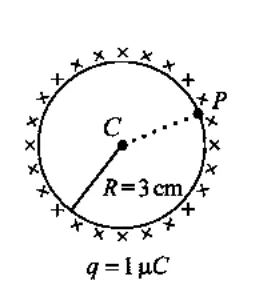
charged spherical shell, R=3 cm, q=1 microC, centre C and surface point P

1. zero

2. \(3\times10^5\)

3. \(1\times10^5\)

4. \(0.5\times10^5\)

1 answer

Best answer

Answer: 1. zero

Key idea: For a charged shell, the potential is the same at every point inside and on the surface: \(V=\frac{kq}{R}\).

C is the centre and P lies on the surface. Both are at potential \(\frac{kq}{R}\), so \(V_C-V_P=0\).

(The field is zero inside, so no work is done moving a charge between C and P.) Option 1.

Doubtly AI · 30 Oct 2026 AI-generated · not yet verified Report
Was this answer helpful?

Your answer

Log in or create a free account to answer this question.