
Topic: Electric potential, potential difference, equipotential surfaces· Electrostatics
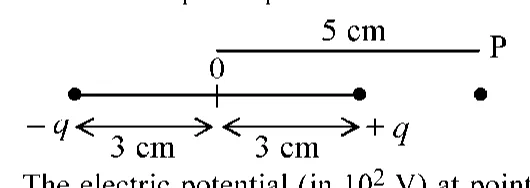
An electric dipole is placed as shown in the figure. The electric potential (in 10^2 V) at point P due to the dipole is (ε_0 = permittivity of free space and 1/4πε_0=K):
An electric dipole is placed as shown in the figure. The electric potential (in \(10^2\) V) at point P due to the dipole is (\(\epsilon_0\) = permittivity of free space and \(\frac{1}{4\pi\epsilon_0}=K\)):
1. \(\left(\frac{8}{3}\right)qK\)
2. \(\left(\frac{3}{8}\right)qK\)
3. \(\left(\frac{5}{8}\right)qK\)
4. \(\left(\frac{8}{5}\right)qK\)