Skip to content
doubtly
Topic: Wheatstone bridge and metre bridge· Current Electricity

A wheatstone bridge is used to determine the value of unknown resistance X by adjusting the variable resistance Y as shown in the figure. For the most precise measurement of X, the resistances P and Q :
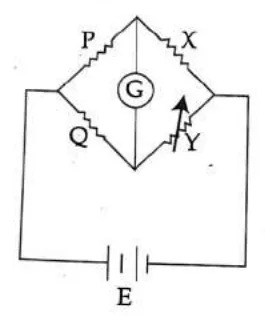
A wheatstone bridge is used to determine the value of unknown resistance X by adjusting the variable resistance Y as shown in the figure. For the most precise measurement of X, the resistances P and Q :

Wheatstone bridge with P, X, Q, Y, galvanometer G and battery E

1. do not play any significant role

2. should be approximately equal to 2X

3. should be approximately equal and are small

4. should be very large and unequal

Doubtly Asked Updated NEET UG 2022 Practice test neet Save WhatsApp Report

1 answer

Best answer

Correct option: (3) should be approximately equal and are small

In a Wheatstone bridge, \(X=\dfrac{Q}{P}\,Y\) at balance. The measurement is most precise when the bridge is most sensitive, i.e. when a small change in \(Y\) away from balance produces a clearly visible galvanometer deflection.

  • Sensitivity is highest when all four arms have resistances of the same order. So P and Q should be nearly equal to each other (ratio close to 1), and then Y comes out close to X.
  • If P and Q are small, more current flows through the arms and the galvanometer, so the deflection near balance is larger and the null point is located more accurately.

Option (1) is wrong because P and Q decide the sensitivity; option (4) (very large, unequal) reduces sensitivity; option (2) fixes an arbitrary value with no reason. Hence option (3).

Doubtly AI · 31 Oct 2026 AI-verified · Nov 2026 Report
Was this answer helpful?

Practise this chapter

Current Electricity

Take the chapter test 16 questions · 16 min · free

Your answer

Log in or create a free account to answer this question.