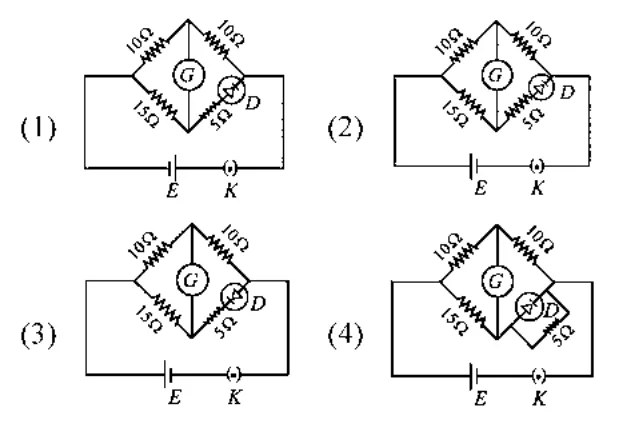
Correct option: (1) circuit (1)
Key idea: A Wheatstone bridge is balanced (no current through G) when \(\dfrac{P}{Q}=\dfrac{R}{S}\).
- In every circuit the arms are: top-left \(10\,\Omega\), top-right \(10\,\Omega\), bottom-left \(15\,\Omega\), and bottom-right \(5\,\Omega\) in series with the diode D.
- Balance needs \(\dfrac{10}{10}=\dfrac{15}{5+r_d}\), so the diode must conduct and offer a resistance \(r_d=10\,\Omega\). A real diode that is forward-biased does have such a (dynamic) resistance, so balance is possible only if the diode is forward-biased.
- If the diode is reverse-biased, no current flows in the bottom-right arm (it behaves like an open arm), so the bridge cannot balance.
- In circuit (1) the battery's positive terminal is connected to the right-hand node, so current flows from the right node down through D and the \(5\,\Omega\) resistor in the diode's forward direction: D conducts.
- In circuits (2) and (3) the battery is connected the other way, so the same diode is reverse-biased. In circuit (4) the diode is in parallel with the \(5\,\Omega\) resistor, so the arm resistance can never reach \(15\,\Omega\).
Only circuit (1) can achieve balance: option (1).