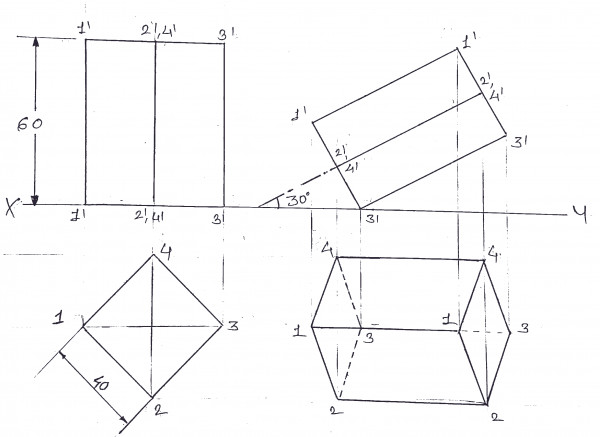
Answer: Solve in two stages: first draw the prism with its axis perpendicular to the H.P. (base on H.P.), then tilt the front view about a base corner so the axis is at 30° to XY and project the new top view.
Given: square prism, base side 40 mm, axis 60 mm; rests on the H.P. on a base corner; axis inclined at 30° to the H.P. and parallel to the V.P.
Stage 1 (axis perpendicular to H.P.):
- Top view: draw a square of side 40 mm with one diagonal parallel to XY (sides at 45° to XY). Its diagonal is \( 40\sqrt{2} \approx 56.6 \) mm, so the two end corners are the extreme left and right points.
- Front view: project upwards to get a rectangle 56.6 mm wide and 60 mm high standing on XY, with the middle vertical edge showing the front and back lateral edges together. Name all corners (base 1′,2′,3′,4′ and top a′,b′,c′,d′).
Stage 2 (tilt the front view):
- Since the axis stays parallel to the V.P., only the front view changes shape. Redraw the Stage 1 front view tilted so that one extreme base corner lies on XY and the axis makes 30° with XY. (Equivalently, the base makes 60° with XY, because base and axis are perpendicular.)
- Top view: draw projectors down from every corner of the tilted front view and horizontal lines from the matching corners of the Stage 1 top view. Their intersections give the new top view.
- Join the corners in order: base square, top square and the four lateral edges.
Visible and hidden lines: in the top view the edges of the face that is uppermost in the front view are visible; edges lying below and behind it are shown dashed. In the front view the outline is always visible and an edge is dashed only if it lies behind a visible face (here the front and back lateral edges coincide, so no hidden line appears).