Skip to content
doubtly

Structural Organisation in Animals and Plants

71 solved questions 3 tests

Take chapter test ← Previous Next chapter →

Every question from past board papers on Structural Organisation in Animals and Plants, newest paper first. Open any question for its full worked answer.

NEET UG 2025 question paper (official, booklet 45)

Full paper →
  1. Given below are two statements :

    Statement I : In a floral formula ⊕ stands for zygomorphic nature of the flower, and G (underlined) stands for inferior ovary.

    Statement II : In a floral formula ⊕ stands for actinomorphic nature of the flower and G (underlined) stands for superior ovary.

    In the light of the above statements, choose the correct answer from the options given below :
    4 marks · See worked answer →

  2. Find the statement that is NOT correct with regard to the structure of monocot stem.

    4 marks · See worked answer →

  3. In the seeds of cereals, the outer covering of endosperm separates the embryo by a protein-rich layer called :

    4 marks · See worked answer →

  4. Match List I with List II :

    List I: A. Scutellum B. Non-albuminous seed C. Epiblast D. Perisperm

    List II: I. Persistent nucellus II. Cotyledon of Monocot seed III. Groundnut IV. Rudimentary cotyledon

    Choose the option with all correct matches.

    4 marks · See worked answer →

  5. Which of the following is an example of a zygomorphic flower?

    4 marks · See worked answer →

NEET UG 2024 question paper (official, booklet S6)

Full paper →
  1. Given below are two statements:

    Statement I : Parenchyma is living but collenchyma is dead tissue.

    Statement II : Gymnosperms lack xylem vessels but presence of xylem vessels is the characteristic of angiosperms.

    In the light of the above statements, choose the correct answer from the options given below:

    4 marks · See worked answer →

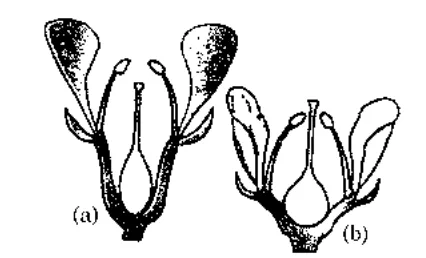
  2. Identify the type of flowers based on the position of calyx, corolla and androecium with respect to the ovary from the given figures (a) and (b)

    two flower longitudinal sections (a) and (b) showing ovary position

    4 marks · See worked answer →

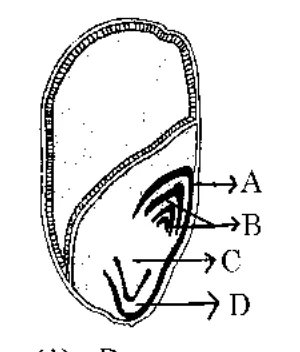
  3. Identify the part of the seed from the given figure which is destined to form root when the seed germinates.

    longitudinal section of a monocot seed with labelled parts A, B, C, D

    4 marks · See worked answer →

  4. Which of the following is an example of actinomorphic flower?

    4 marks · See worked answer →

  5. Bulliform cells are responsible for

    4 marks · See worked answer →

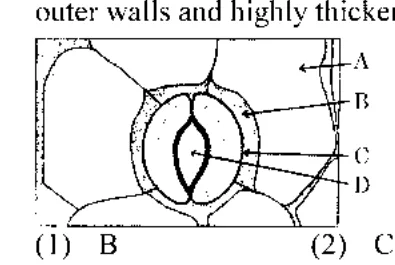
  6. In the given figure, which component has thin outer walls and highly thickened inner walls?

    stomatal guard cells with labelled parts A, B, C, D

    4 marks · See worked answer →

  7. Match List I with List II

    List I (Types of Stamens): A. Monoadelphous; B. Diadelphous; C. Polyadelphous; D. Epiphyllous

    List II (Example): I. Citrus; II. Pea; III. Lily; IV. China-rose

    Choose the correct answer from the options given below:

    4 marks · See worked answer →

  8. Match List I with List II

    List I: A. Rose; B. Pea; C. Cotton; D. Mango

    List II: I. Twisted aestivation; II. Perigynous flower; III. Drupe; IV. Marginal placentation

    Choose the correct answer from the options given below:

    4 marks · See worked answer →

NEET UG 2023 question paper (official, booklet G6)

Full paper →
  1. Family Fabaceae differs from Solanaceae and Liliaceae. With respect to the stamens, pick out the characteristics specific to family Fabaceae but not found in Solanaceae or Liliaceae.

    4 marks · See worked answer →

  2. Axile placentation is observed in

    4 marks · See worked answer →

  3. Given below are two statements :

    Statement I : Endarch and exarch are the terms often used for describing the position of secondary xylem in the plant body.

    Statement II : Exarch condition is the most common feature of the root system.

    In the light of the above statements, choose the correct answer from the options given below :
    4 marks · See worked answer →

  4. Given below are two statements : One is labelled as Assertion A and the other is labelled as Reason R :

    Assertion A : Late wood has fewer xylary elements with narrow vessels.

    Reason R : Cambium is less active in winters.

    In the light of the above statements, choose the correct answer from the options given below :
    4 marks · See worked answer →

  5. Identify the correct statements :

    A. Lenticels are the lens-shaped openings permitting the exchange of gases.

    B. Bark formed early in the season is called hard bark.

    C. Bark is a technical term that refers to all tissues exterior to vascular cambium.

    D. Bark refers to periderm and secondary phloem.

    E. Phellogen is single-layered in thickness.

    Choose the correct answer from the options given below :

    4 marks · See worked answer →

  6. Given below are two statements : One is labelled as Assertion A and the other is labelled as Reason R :

    Assertion A : A flower is defined as modified shoot wherein the shoot apical meristem changes to floral meristem.

    Reason R : Internode of the shoot gets condensed to produce different floral appendages laterally at successive nodes instead of leaves.

    In the light of the above statements, choose the correct answer from the options given below :
    4 marks · See worked answer →

NEET UG 2022 question paper (official, booklet R6)

Full paper →
  1. Which of the following is not observed during apoplastic pathway ?

    4 marks · See worked answer →

  2. Read the following statements about the vascular bundles :

    (a) In roots, xylem and phloem in a vascular bundle are arranged in an alternate manner along the different radii.

    (b) Conjoint closed vascular bundles do not possess cambium

    (c) In open vascular bundles, cambium is present in between xylem and phloem

    (d) The vascular bundles of dicotyledonous stem possess endarch protoxylem

    (e) In monocotyledonous root, usually there are more than six xylem bundles present

    Choose the correct answer from the options given below :
    4 marks · See worked answer →

  3. The flowers are Zygomorphic in :

    (a) Mustard

    (b) Gulmohar

    (c) Cassia

    (d) Datura

    (e) Chilly

    Choose the correct answer from the options given below :

    4 marks · See worked answer →

  4. In old trees the greater part of seco[...] dark brown and resistant to insect attack due [...]

    (a) secretion of secondary metabolites and their deposition in the lumen of vessels.

    (b) deposition of organic compounds like tannins and resins in the central layers of stem.

    (c) deposition of suberin and aromatic substances in the outer layer of stem.

    (d) deposition of tannins, gum, resin and aromatic substances in the peripheral layers of stem.

    (e) presence of parenchyma cells, functionally active xylem elements and essential oils.

    Choose the correct answer from the options given below :

    4 marks · See worked answer →

  5. Identify the correct set of statements :

    (a) The leaflets are modified into pointed hard thorns in Citrus and Bougainvillea

    (b) Axillary buds form slender and spirally coiled tendrils in cucumber and pumpkin

    (c) Stem is flattened and fleshy in Opuntia and modified to perform the function of leaves

    (d) Rhizophora shows vertically upward growing roots that help to get oxygen for respiration

    (e) Subaerially growing stems in grasses and strawberry help in vegetative propagation

    Choose the correct answer from the options given below :

    4 marks · See worked answer →

  6. Which one of the following plants shows vexillary aestivation and diadelphous stamens ?

    4 marks · See worked answer →

  7. "Girdling Experiment" was performed by Plant Physiologists to identify the plant tissue through which :

    4 marks · See worked answer →

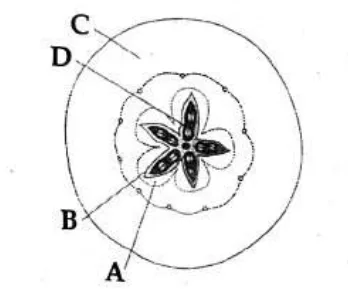
  8. Which part of the fruit, labelled in the given figure makes it a false fruit ?

    Cross-section of fruit with labels A-D

    4 marks · See worked answer →

  9. The anatomy of springwood shows some peculiar features. Identify the correct set of statements about springwood.

    (a) It is also called as the earlywood

    (b) In spring season cambium produces xylem elements with narrow vessels

    (c) It is lighter in colour

    (d) The springwood along with autumnwood shows alternate concentric rings forming annual rings

    (e) It has lower density

    Choose the correct answer from the options given below :

    4 marks · See worked answer →

NEET UG 2021 question paper (official, booklet M4)

Full paper →
  1. Match List - I with List - II.

    List - I | List - II

    (a) Cells with active cell division capacity | (i) Vascular tissues

    (b) Tissue having all cells similar in structure and function | (ii) Meristematic tissue

    (c) Tissue having different types of cells | (iii) Sclereids

    (d) Dead cells with highly thickened walls and narrow lumen | (iv) Simple tissue

    Select the correct answer from the options given below.

    4 marks · See worked answer →

  2. Match List - I with List - II.

    List - I | List - II

    (a) Lenticels | (i) Phellogen

    (b) Cork cambium | (ii) Suberin deposition

    (c) Secondary cortex | (iii) Exchange of gases

    (d) Cork | (iv) Phelloderm

    Choose the correct answer from the options given below.

    4 marks · See worked answer →

  3. Diadelphous stamens are found in :

    4 marks · See worked answer →

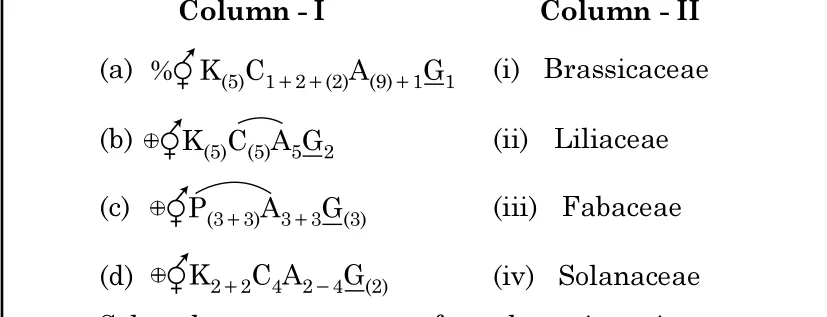
  4. Match Column - I with Column - II.

    Column - I (floral formulae) | Column - II

    (a) %♀♂ K(5) C1+2+(2) A(9)+1 G̱(1) | (i) Brassicaceae

    (b) ⊕♀♂ K(5) C(5) A5 G̱(2) | (ii) Liliaceae

    (c) ⊕♀♂ P(3+3) A3+3 G̱(3) | (iii) Fabaceae

    (d) ⊕♀♂ K2+2 C4 A2−4 G̱(2) | (iv) Solanaceae

    Select the correct answer from the options given below.

    floral formulae in Column I (a)-(d)

    4 marks · See worked answer →

  5. Select the correct pair.

    4 marks · See worked answer →

NEET UG 2020 question paper (official, booklet E1)

Full paper →
  1. The roots that originate from the base of the stem are :

    4 marks · See worked answer →

  2. Ray florets have :

    4 marks · See worked answer →

  3. Identify the incorrect statement.

    4 marks · See worked answer →

  4. The transverse section of a plant shows following anatomical features :

    (a) Large number of scattered vascular bundles surrounded by bundle sheath.

    (b) Large conspicuous parenchymatous ground tissue.

    (c) Vascular bundles conjoint and closed.

    (d) Phloem parenchyma absent.

    Identify the category of plant and its part :

    4 marks · See worked answer →

  5. The ovary is half inferior in :

    4 marks · See worked answer →

NEET UG 2019 question paper (official, booklet P1)

Full paper →
  1. Grass leaves curl inwards during very dry weather. Select the most appropriate reason from the following :

    4 marks · See worked answer →

  2. Xylem translocates :

    4 marks · See worked answer →

  3. Which of the statements given below is not true about formation of Annual Rings in trees ?

    4 marks · See worked answer →

  4. Placentation, in which ovules develop on the inner wall of the ovary or in peripheral part, is :

    4 marks · See worked answer →

  5. Phloem in gymnosperms lacks :

    4 marks · See worked answer →

NEET UG 2018 question paper (official, booklet EE)

Full paper →
  1. Pneumatophores occur in

    4 marks · See worked answer →

  2. Sweet potato is a modified

    4 marks · See worked answer →

  3. Plants having little or no secondary growth are

    4 marks · See worked answer →

  4. Casparian strips occur in

    4 marks · See worked answer →

  5. Secondary xylem and phloem in dicot stem are produced by

    4 marks · See worked answer →

  6. Stomata in grass leaf are

    4 marks · See worked answer →

NEET UG 2017 question paper (official, booklet B)

Full paper →
  1. Identify the wrong statement in context of heartwood :

    4 marks · See worked answer →

  2. Root hairs develop from the region of :

    4 marks · See worked answer →

  3. Which of the following facilitates opening of stomatal aperture ?

    4 marks · See worked answer →

  4. The vascular cambium normally gives rise to :

    4 marks · See worked answer →

  5. The morphological nature of the edible part of coconut is :

    4 marks · See worked answer →

  6. Coconut fruit is a :

    4 marks · See worked answer →

  7. In Bougainvillea thorns are the modifications of :

    4 marks · See worked answer →

  8. Which of the following is made up of dead cells ?

    4 marks · See worked answer →

NEET UG 2016 Phase 1 question paper (official, booklet A)

Full paper →
  1. The standard petal of a papilionaceous corolla is also called :

    4 marks · See worked answer →

  2. Tricarpellary, syncarpous gynoecium is found in flowers of :

    4 marks · See worked answer →

  3. Proximal end of the filament of stamen is attached to the :

    4 marks · See worked answer →

  4. Which of the following is not a stem modification ?

    4 marks · See worked answer →

  5. Cotyledon of maize grain is called :

    4 marks · See worked answer →

  6. Specialised epidermal cells surrounding the guard cells are called :

    4 marks · See worked answer →

  7. Stems modified into flat green organs performing the functions of leaves are known as :

    4 marks · See worked answer →

NEET UG 2016 Phase 2 question paper (official, booklet ZZ)

Full paper →
  1. Match Column—I with Column—II and select the correct option using the codes given below :

    Column—I: a. Pistils fused together; b. Formation of gametes; c. Hyphae of higher Ascomycetes; d. Unisexual female flower

    Column—II: (i) Gametogenesis; (ii) Pistillate; (iii) Syncarpous; (iv) Dikaryotic

    Codes: a b c d

    4 marks · See worked answer →

  2. The term 'polyadelphous' is related to

    4 marks · See worked answer →

  3. How many plants among *Indigofera*, *Sesbania*, *Salvia*, *Allium*, *Aloe*, mustard, groundnut, radish, gram and turnip have stamens with different lengths in their flowers?

    4 marks · See worked answer →

  4. Radial symmetry is found in the flowers of

    4 marks · See worked answer →

  5. Free-central placentation is found in

    4 marks · See worked answer →

  6. Cortex is the region found between

    4 marks · See worked answer →

  7. The balloon-shaped structures called tyloses

    4 marks · See worked answer →