
In a certain camera, a combination of four similar thin convex lenses are arranged axially in contact. Then the power of the combination and the total magnification in comparison to the power (\(p\)) and magnification (\(m\)) for each lens will be, respectively -
Magnification, power of lens, combination of thin lenses
Every question from past board papers on Magnification, power of lens, combination of thin lenses, newest paper first. Open any question for its full worked answer.
NEET UG 2025 question paper (official, booklet 45)
Full paper →NEET UG 2023 question paper (official, booklet G6)
Full paper →-
In the figure shown here, what is the equivalent focal length of the combination of lenses (Assume that all layers are thin)?
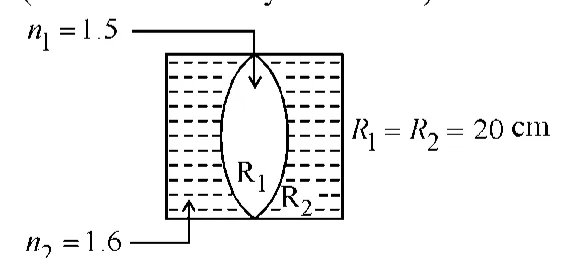
-
Two thin lenses are of same focal lengths (\(f\)), but one is convex and the other one is concave. When they are placed in contact with each other, the equivalent focal length of the combination will be :
NEET UG 2022 question paper (official, booklet R6)
Full paper →-
A biconvex lens has radii of curvature, 20 cm each. If the refractive index of the material of the lens is 1.5, the power of the lens is :
NEET UG 2021 question paper (official, booklet M4)
Full paper →-
A convex lens 'A' of focal length 20 cm and a concave lens 'B' of focal length 5 cm are kept along the same axis with a distance 'd' between them. If a parallel beam of light falling on 'A' leaves 'B' as a parallel beam, then the distance 'd' in cm will be :
NEET UG 2019 question paper (official, booklet P1)
Full paper →-
Two similar thin equi-convex lenses, of focal length \(f\) each, are kept coaxially in contact with each other such that the focal length of the combination is \(F_1\). When the space between the two lenses is filled with glycerin (which has the same refractive index (\(\mu = 1.5\)) as that of glass) then the equivalent focal length is \(F_2\). The ratio \(F_1 : F_2\) will be :
NEET UG 2016 Phase 1 question paper (official, booklet A)
Full paper →-
Match the corresponding entries of column 1 with column 2. [Where m is the magnification produced by the mirror]
Column 1: (A) \(m = -2\); (B) \(m = -\frac{1}{2}\); (C) \(m = +2\); (D) \(m = +\frac{1}{2}\)
Column 2: (a) Convex mirror; (b) Concave mirror; (c) Real image; (d) Virtual image
NEET UG 2016 Phase 2 question paper (official, booklet ZZ)
Full paper →-
Two identical glass (\(\mu_g=3/2\)) equiconvex lenses of focal length \(f\) each are kept in contact. The space between the two lenses is filled with water (\(\mu_w=4/3\)). The focal length of the combination is
-
A person can see clearly objects only when they lie between 50 cm and 400 cm from his eyes. In order to increase the maximum distance of distinct vision to infinity, the type and power of the correcting lens, the person has to use, will be